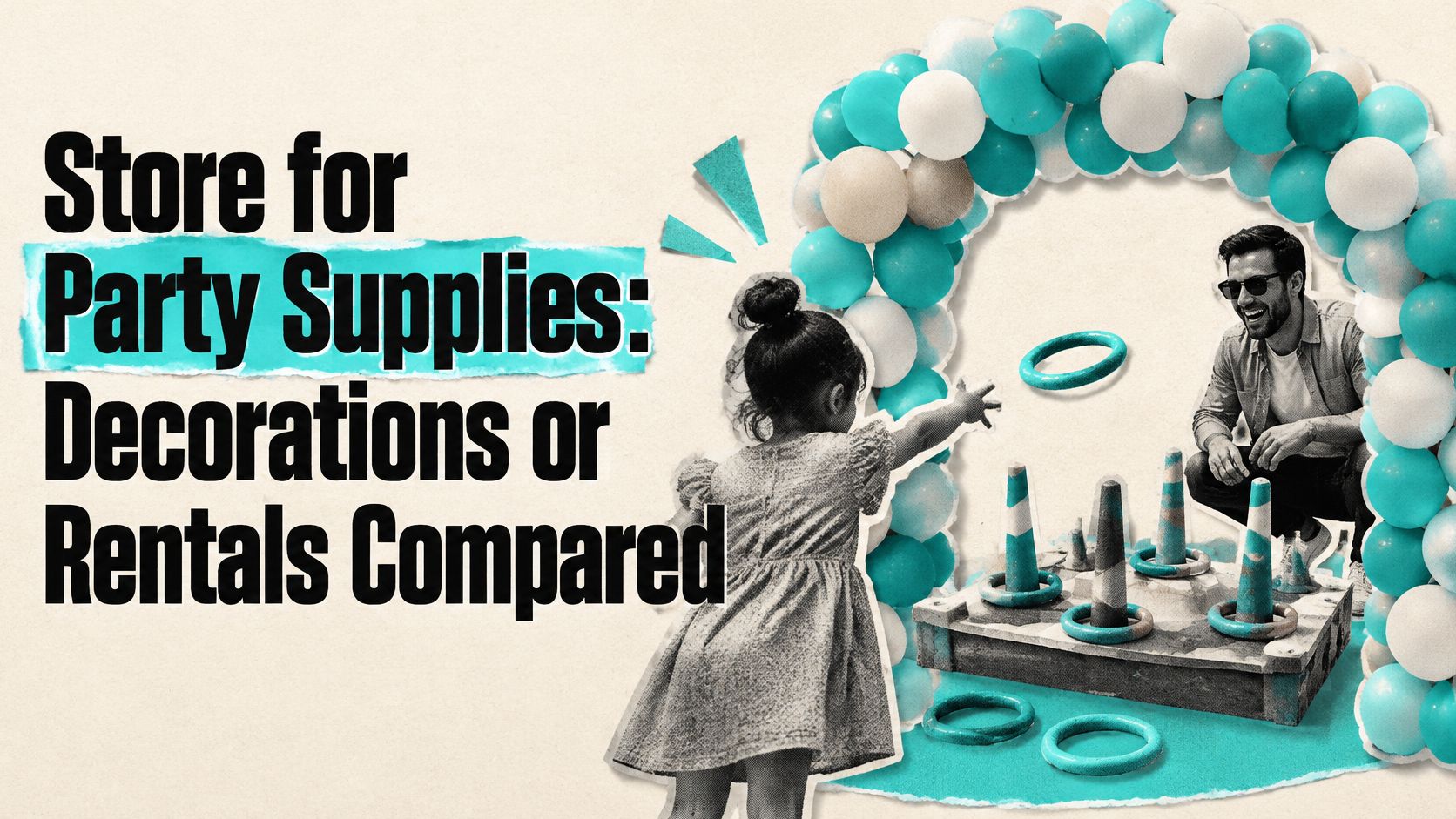
You're standing in a store for party supplies with a trolley half full of balloons, a backdrop and themed cups, and you're still not sure what guests will do for two hours. That's the gap most budgets miss. Decor might make the photos, but it won't fill the time between arrival and cake.
Treat this as one budget decision, not two separate shopping trips. Decide what to buy, what to rent, and who'll do the setup, storage and weather backup before you pay for either.
Table of Contents
- Decorations Versus Rentals at a Glance
- Where to Shop for Party Supplies
- What Decorations and Rentals Each Do
- Cost, Setup and Hidden Labour Compared
- Guest Experience for Mixed-Age Groups
- Weather and Safety Plan for Outdoor Events
- Buy or Rent by Event Type
- Confirm Your Mix Before You Book
Decorations Versus Rentals at a Glance
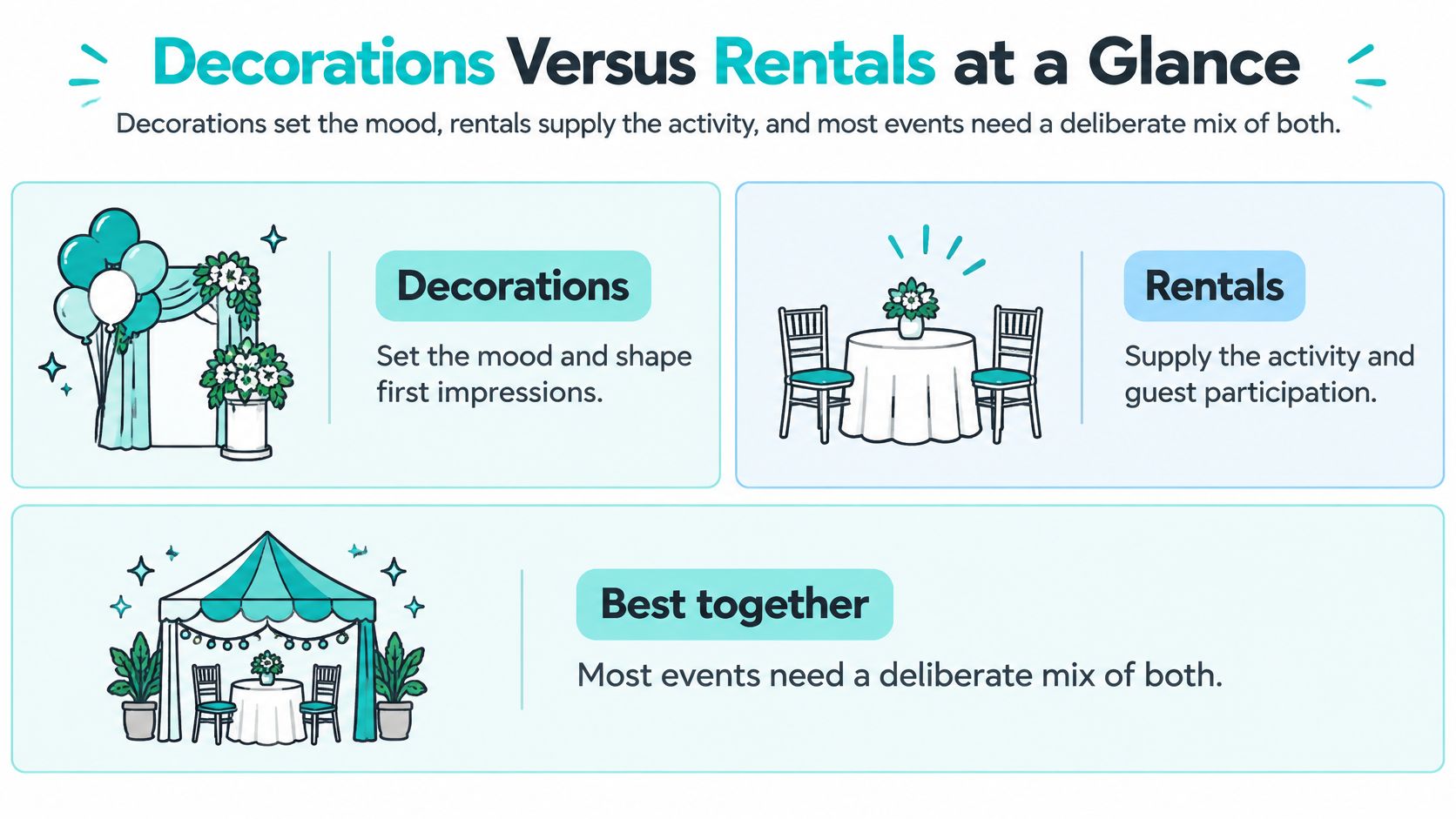
Decorations set the mood, rentals supply the activity, and most events need a deliberate mix of both. If you're short on time, start there and split your money accordingly.
| Criterion | Buying decorations | Renting activities |
|---|---|---|
| Main job | Sets the look and mood | Gives guests something to do |
| Cost pattern | One-off purchase per item | Priced per session or package |
| Setup and takedown | Usually your helpers | Often included in the package |
| Leftovers | You store or discard them | Nothing to store afterwards |
| Guest participation | Passive | Active, team-based play |
| Flexibility | Easy to change on the day | Booked ahead for a fixed slot |
A table can't show labour. A single trip to a store for party decor looks cheap per item, but you'll spend hours assembling arches, inflating balloons, taping banners and clearing it all afterwards. If you want to compare that effort with hired styling, you can find party decor hire ideas and see what work shifts to someone else.
A rented activity works differently. It's priced by session and participant count, so it rarely fills a whole evening on its own. I would use it as the centrepiece and build food, cake and free time around it, not expect it to carry every minute.
The cheapest-looking option is often the one needing fewest helpers on the day. Count hands, not just shelf prices.
Practical rule: If guests need something to do, budget for a rental. If the room needs to look different, budget for decorations. If you need both, reserve part of the total for setup.
Where to Shop for Party Supplies
Planners in Singapore usually use three types of supplier. A dedicated party supply shop is best for balloons, foil and latex decor, tableware, banners, costumes and character sets. General retail suits bulk basics such as paper goods, tape, ribbon and string lights. A specialist rental provider suits games, inflatables and staffed programmes that need equipment and supervision.
Browsing curated ranges such as party picks from Bridle Up Hope Shop can help you shortlist colours and small items, but don't let a themed set decide your whole plan. For activities, compare what's bundled in our party packages before you commit decor money.
A Quick Shopping Checklist
- Count first: Multiply guests by plates, cups and napkins, then add spares for drops and seconds.
- Buy fragile items late: Get balloons close to the event and keep receipts for unopened returns.
- Check pack maths: A bulk pack only saves money if you'll use most of it.
- Ask about holding stock: Confirm the store can reserve your theme for your date or restock it.
- Test rental detail: Request the equipment list, staffing, setup time and whether delivery's included.
- Measure storage: Don't buy bulk decor if you've nowhere dry to keep it afterwards.
Before paying any store, ask about current stock for your date, the return policy, delivery windows and whether pieces can be reused. Those answers change the actual cost fast.
What Decorations and Rentals Each Do
Think of decorations as the stage set and props. Rentals are the scripted scenes the audience joins in. Both matter, but they solve different problems.
The photo below shows what decor does well before anyone has spoken.
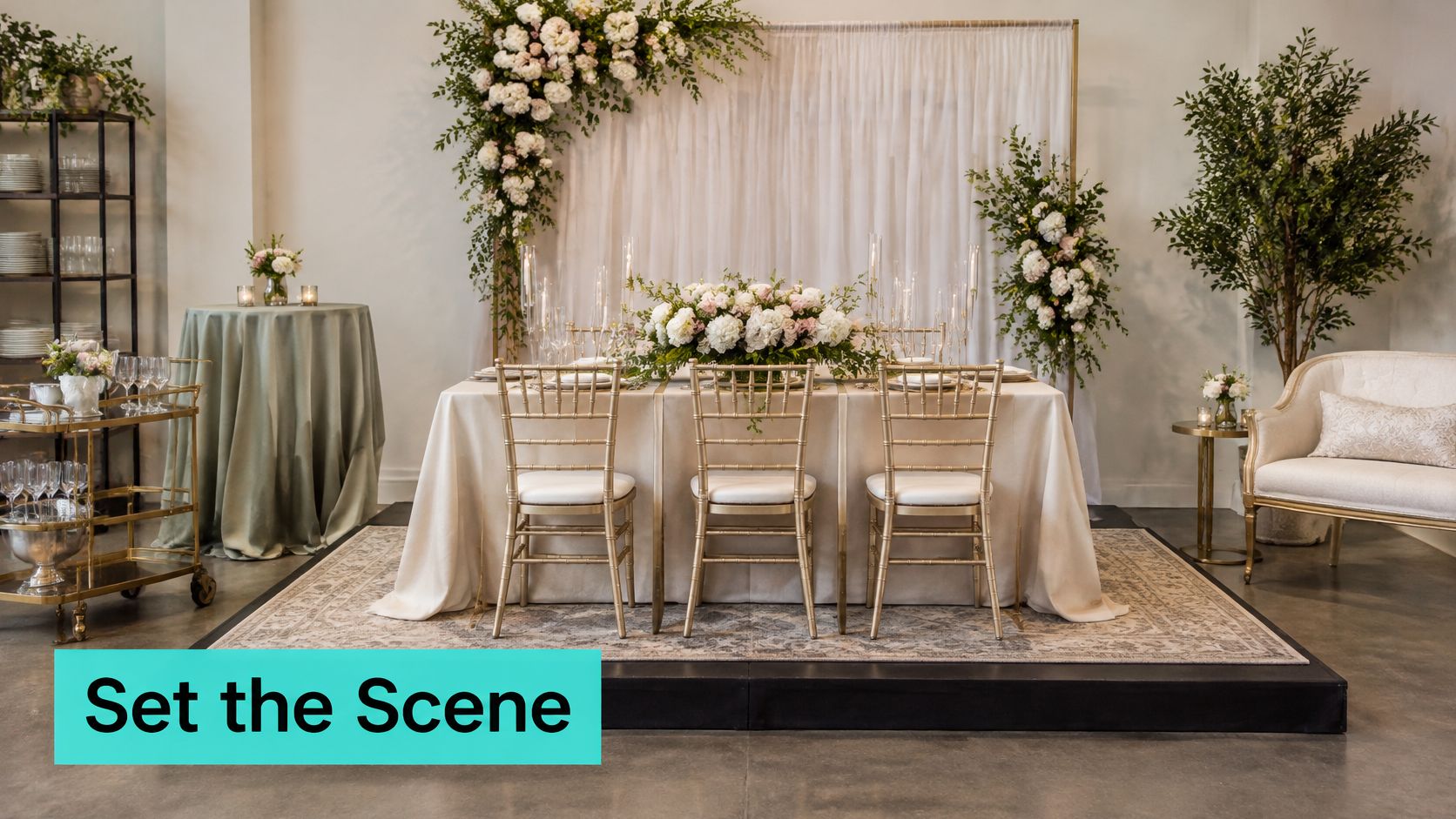
Decorations shape first impressions, photographs and theme. A backdrop tells guests where to stand, table colours tie a cake to a character, and signage stops people wandering. Decor works even when nobody moves. A grandparent who's seated all afternoon still experiences it.
Rentals create shared moments. They give strangers a reason to talk, children a reason to run in an organised way, and colleagues something to laugh about together. They also depend on people being present, willing and able to join, which is why timing and facilitation matter.
A Worked Birthday Example
Say you're planning a superhero-themed seventh birthday at home. Your decor is a balloon arch at the gate, a city-skyline backdrop for photos, capes on each chair and themed tableware. Your rental is a Bloop Bubble Soccer session in the backyard, run in short rounds so children can rest and swap teams.
Remove the decor and the game still works, but photos look generic and children arrive without that instant superhero cue. Remove the rental and the room looks great for ten minutes, then guests drift to phones after cake because there's no next thing to do.
This short clip shows the energy a facilitated activity adds once the set is in place.
Edge cases prove the split. A small adult dinner may need only table decor, candles and one short team game between courses. A school sports day usually needs functional decor, such as banners and team markers, alongside full equipment rentals that keep many classes moving to a timetable.
Decorations answer what the space looks like. Rentals answer what people do in it.
Use that test for every line item. If an item doesn't improve the look or give guests something to do, it's probably not earning its place in the trolley.
Cost, Setup and Hidden Labour Compared
Compare the full cost, not the sticker. Decorations are a one-off purchase per item, but you also pay in time for hanging, inflating, adjusting and clearing away. Afterwards you're storing half-used packs or binning them.
Rentals are priced per session or package, with participant numbers and duration setting the total. Some packages charge extra for each additional participant, so a vague guest count makes quotes unreliable. Check current rental rates and package inclusions against your actual headcount, not your hopeful one.
Four Costs to Total First
- Quoted or shelf price: The amount on the tag or proposal, before extras.
- Venue or facility fees: Charges that may apply depending on activity and location.
- Helper hours: Who builds, supervises, packs down and stays late.
- Afterwards: Storage boxes, disposal bags, returns trips and damaged items.
Each of our party packages includes setup and takedown services, which removes a large block of labour from your list. That doesn't make rentals automatically cheaper. It means you're buying time and fewer volunteers, and you should value that if your helpers are also your guests.
Decor keeps costs visible but labour hidden. Rentals move labour into the quote but can add venue charges. I would write both totals side by side before deciding.
Why Inflatables Change the Quote
A large inflatable isn't just recreational equipment in Singapore. The Singapore Civil Defence Force fire safety conditions for outdoor inflatable tentages require inflatable tentages to be positioned at least 3 metres from building façades, supported by steel frames or trusses, fitted with automatic detection that signals deflation, and surrounded by evacuation-compatible barricades. Fire-retardant material must meet at least BS 476 Part 7 Class 2 or an equivalent certified standard, and tentages larger than 400 square metres require a manual alarm system and sufficient fire-hose-reel coverage.
That affects footprint, exit routes, generator placement, emergency access and setup time. For public locations, a Non-Renewable Temporary Occupation Licence may also be required, so build approval lead time into your booking.
The decisive question is simple. Who handles the layout, permissions and safety checks, you or the provider? If it's you, that work belongs in your cost comparison.
Guest Experience for Mixed-Age Groups
Say your guest list includes a six-year-old who wants to run nonstop, a grandparent who'd rather sit and watch, and a shy colleague who'll only join with a clear job. A single high-energy game won't serve all three equally.
Decorations don't exclude anyone. They're passive, and every guest gets the same backdrop and table. Rentals can exclude people who can't run, catch, balance or tolerate loud noise, unless you design roles around them.
That's backed by the focus of Sport Singapore's children's sport and exercise participation research, which examines children aged 3 to 12 and their barriers to staying active. Availability alone doesn't guarantee a child will join in.
Give People More Than One Way to Matter
Build multiple contribution roles into every game.
- Player: Runs, throws or takes the active turn.
- Timekeeper and scorer: Controls rounds and announces results, seated if needed.
- Strategist: Chooses tactics and player rotation between rounds.
- Launcher or referee: Starts play, checks boundaries and keeps turns fair.
Rotate roles so seated jobs don't feel like consolation prizes. Form teams by random draw or mixed-age pairs, and pick captains by role rather than speed. You'll avoid the awkward line-up where slower participants are chosen last.
For more formats that work across ages, browse birthday party ideas for kids and adults in Singapore and note which ones allow seated or low-intensity roles.
Venue Checks Before You Book
Ask about step-free routes, accessible toilets, rest areas, typical noise levels and safe transfer space for wheelchair users. Also ask how a game adapts for sensory or coordination differences, and whether a child can switch roles mid-session without stopping play.
"Can everyone contribute to the same game, even if they don't all play it the same way?"
If a provider can't answer that clearly, the activity may still be fun, but it isn't yet inclusive. Keep asking until the plan fits your actual guests, not an idealised group.
Weather and Safety Plan for Outdoor Events
Outdoor plans in Singapore need rainfall maths, not optimism. SingStat's environment data explainer reports Changi recorded 2,432.0 mm of rainfall in 2024, which was 15.1% above its long-term average of 2,113.3 mm.
More rain exposure raises the odds of slippery surfaces, equipment downtime, delayed setup and cancellations. Inflatables, water-based games and ball activities are especially exposed because ground conditions and electrical equipment don't mix well with standing water. Wet turf also slows the setup and takedown window built into a booked session, so a rainy morning can shorten actual play time even when the event goes ahead.
Separate Heat, Rain, Lightning and Haze
Heat stress guidance applies to prolonged outdoor activity under direct sun. Your controls are hydration, extra breaks, shade and scheduling active play during cooler hours. Put water where players exit the game, not across the venue.
Heavy rain is a surface and visibility problem. Lightning is a stop-play problem. Haze is a breathing and exertion problem. One vague bad weather rule fails all four, because the right response differs each time.
Heavy thundery showers and flash floods are common during the Northeast Monsoon, which generally runs from December to early March. Drainage and covered storage matter as much as the forecast on the morning itself, so walk the venue after rain before your event date if you can.
Trigger-Based Rules to Agree in Advance
- Name the decision-maker: One organiser and the provider's lead facilitator decide jointly. Guests don't vote on safety.
- Pause for thunder: Stop all active play at the first thunder or lightning. Restart only after 30 minutes without thunder, and confirm that cut-off with the provider and official advisories beforehand.
- Set a rain threshold: Define when you delay setup, move indoors or reschedule, and who notifies parents or guests.
- Prepare substitutions: Reserve an indoor fallback area and pick lower-exertion games that fit it.
- Protect equipment: Confirm covered storage, drying space and what happens if the ground stays unsafe.
Check official advisories before deployment and again on arrival. Write your thresholds into the quotation and your guest message, so nobody's improvising under pressure while children are already in their sports shoes.
I would rather lose twenty minutes to a cautious pause than spend the rest of the party managing a slip, overheating or damaged equipment. A clear trigger protects your schedule because everyone knows the next step.
Buy or Rent by Event Type
Lead with decorations when the event is mainly about photos, dining or theme and guests don't need to move much. Lead with rentals when success depends on play, team roles or a set schedule. Mix both when the venue's large enough for activity and the theme still matters.
| Event type | Lead with decorations | Lead with rentals | Mix both |
|---|---|---|---|
| Children's birthday at home | Balloon arch, backdrop, tableware | Bloop Bubble Soccer or Water Tag for one session | Themed decor plus one active game |
| School sports day | Team banners and house colours | Floorball, Kin Ball or Tchoukball equipment | Rented games with branded banners |
| Corporate family day | Name tags and table settings | Team games and carnival stations | Rented programme with a themed registration desk |
| Community carnival | Stall signage and lighting | Inflatables and ball games | Mostly rentals with signage and shade |
| Small private dinner | Table settings, candles and music | Rarely the lead option | Decor with one short group game |
How to Read Each Row
A children's birthday at home benefits from a strong visual theme because parents take photos in the first fifteen minutes. After that, one active session stops energy turning into chaos. You don't need five activities, you need one well-timed centrepiece.
A school sports day reverses the priority. Banners and house colours help organisation, but equipment and facilitated rotations keep classes moving. Decor there is functional first, pretty second.
Corporate family days sit in the middle. Name tags, registration signage and table settings make a large group feel hosted. Team games and carnival stations give colleagues and their children a shared task beyond queuing for food.
Community carnivals need rentals to attract and engage crowds, plus signage, lighting, and shade so people can find stalls and rest. Without signage, even good activities underperform because guests can't easily find their way around the site.
A small backyard party for six children is the edge case. One short game plus themed decor is usually enough, and buying a huge decor set or booking a long programme both overshoot. A small private dinner goes further still, decor leads and a rental, if any, stays brief.
When two options compete for a limited budget, the activity usually earns more of it. Guests remember what they did together longer than they remember balloon colours, even if the balloons made the first photo better.
Confirm Your Mix Before You Book
Turn your shortlist into a one-page brief before you contact any store for party items or any rental provider. It'll make quotes comparable and stop impulse buys.
Five Steps Before You Pay
- Write the basics: Guest count, age range, venue and event duration, including setup access.
- Split must-haves: List essential looks separately from essential activities, and mark nice-to-haves clearly.
- Total the cost: Add shelf prices, venue fees, helper hours, storage and disposal to rental quotes.
- Lock the weather plan: Note your indoor fallback, pause triggers and cancellation or rescheduling threshold.
- Send one brief: Give us your date, venue, participant count and chosen activities so we can quote accurately.
Our event rental packages combine multiple games and equipment, and each package is customisable based on the number of participants and the duration of the event. That matters when your guest count changes after invitations go out.
Two reference points help you sense-check scale. The Kin-Ball party package costs $600 for a 1.5 hour session, suitable for 12 to 16 participants. The Water Tag party package costs $300 for a 1 hour session for 10 participants and includes 10 Water Tag cannons and vests and 4 buckets with 30 water bombs.
Use those figures to test proportions, not as a promise for every venue. If your decor trolley is approaching the cost of a full facilitated session, ask whether the look is doing more work than the activity would.
Decorations can usually be bought late, swapped or topped up. Rental dates, facilitators and suitable venues can't. I would lock the activity first, then buy decor to fit the confirmed space, theme and timetable.
Buy the look last, book the activity first, and keep a small reserve for the helpers, fees and weather changes nobody puts on a price tag.
Ready to balance bought decor with an activity your guests will remember? Visit ZOVB SG to explore birthday, school, corporate and carnival rentals with setup included, then send your date, venue and participant count for a personalized quote.