The advice most buyers hear is simple. Pick a theme, book the games, and call that planning. The day will sort itself out. That advice collapses as soon as a school sports day, a corporate family day or a community carnival has several stations, mixed ages and people moving at once.
In Singapore those gatherings are usually management-led, even when the brief looks like a short planning job. Planning sets what you run and for whom. Management decides whether it runs safely and on time. The split shifts with scale and risk, not with the label on a package.
Table of Contents
- Event Planning vs Event Management at a Glance
- What Event Planners Own Before the Day
- What Event Managers Control on the Day
- Splitting Responsibilities Between Planner and Manager
- When You Need a Planner, a Manager or Both
- Brief Your Event Before You Book
Event Planning vs Event Management at a Glance
Provider packages and job titles list event planning and event management as though they were the same line on an invoice. They are not. One decides the shape of the day. The other decides whether it survives contact with real people, weather and a running clock. Buyers who treat them as one job end up with a polished programme and equipment arriving at 2:45pm for a 2pm start.
In Singapore, the weight sits on the management side more often than buyers expect. The Meetings, Incentives, Conventions and Exhibitions sector is a major contributor to the country's jobs and economy, and a school sports day or community carnival runs on the same operational discipline at a smaller scale. Delivery is skilled work in its own right, which is why the boundary between the two roles moves as headcounts and risk climb.
| Criterion | Event Planning | Event Management |
|---|---|---|
| Core question | What should the event achieve, and how is it designed? | How is the plan delivered safely and on time? |
| Main output | Concept, programme, budget, run sheet and supplier brief | Live schedule control, headcount records, incident log and closeout report |
| Typical timing | About 3 to 12 weeks before the event, depending on scale | Final weeks, setup day, the event itself and post-event review |
| Typical owner | Client, school committee, HR team or event designer | Operations lead, facilitators and on-site crew |
| Main risk if weak | Wrong activity mix, unclear objectives or budget overrun | Late equipment, crowd bottlenecks, unsafe play or missed timings |
| Skills emphasised | Design, budgeting, stakeholder briefing and scheduling | Logistics, supervision, incident handling and quick decisions |
Planning decides the shape of the day. Management decides whether the day runs.
Work, not a job title
Planners usually lead from about three to twelve weeks out. Managers take the final weeks, setup day and the event itself. The labels describe work, not a permanent badge, so one person can carry both at a small birthday party in a void deck. The trade-off is real: when one person holds both jobs, nobody checks their blind spots. A school sports day or a mass carnival usually splits the roles across a team for exactly that reason.
A school sports day shows the cut cleanly. The school fixes the theme, the house groups and the learning aim. That is planning. Whether the day runs sits with the people rotating stations, counting heads and keeping a queue clear of the walkway. A Kin-Ball station, where teams work together to keep the giant kinball in play, stays on time only if a facilitator controls each rotation. Mixed ages, active games, weather and several stations running at once push the weight toward the second job.
Quick test: if a failure would show up in the budget or the run sheet, planning owns it. If it would show up in a crowd or a stopped clock, management owns it.
What Event Planners Own Before the Day
Planning is a sequence of decisions you can check on paper, not a mood board. Work through them in order. Skipping one pushes the gap onto the crew on the day.
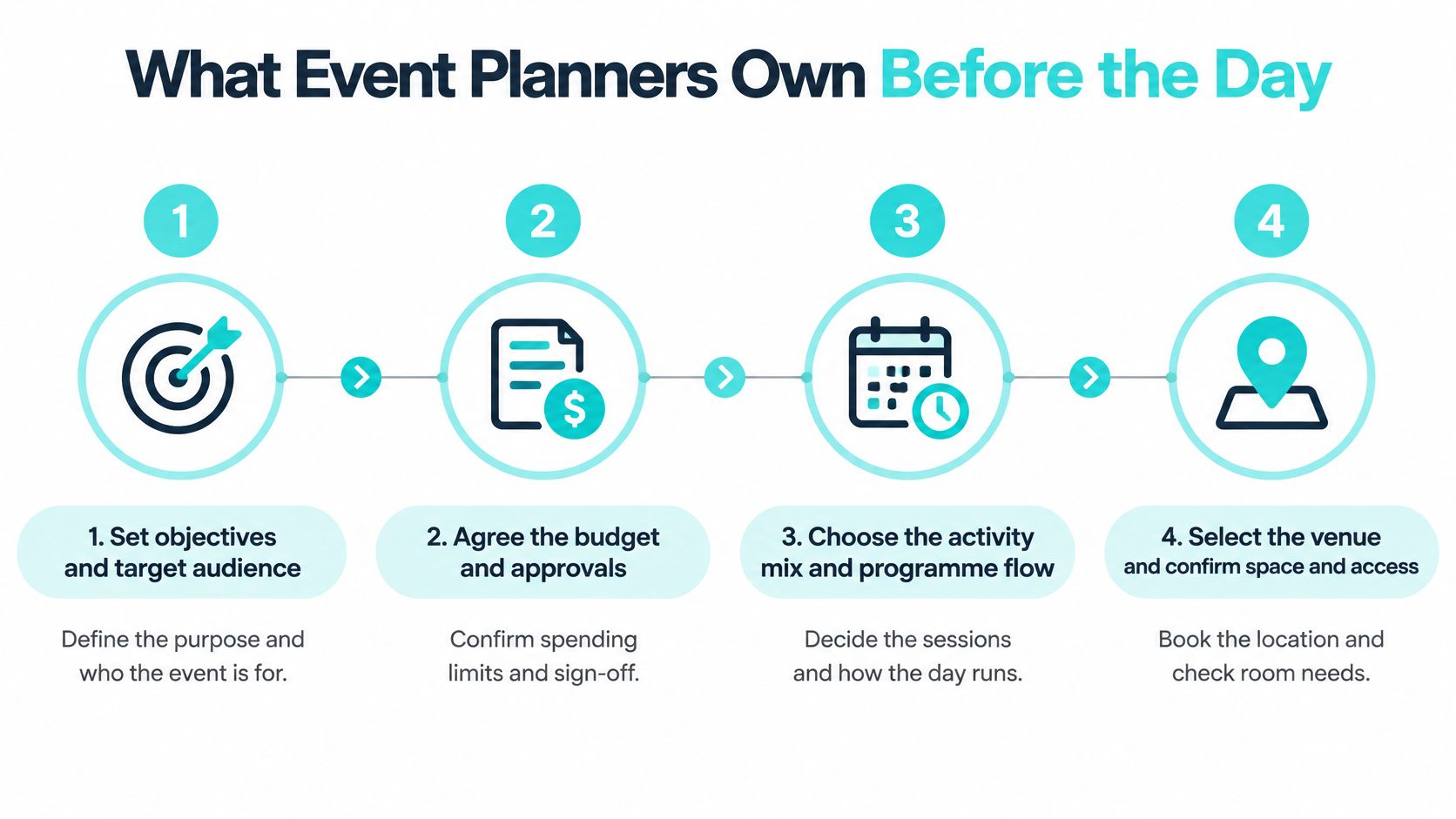
- Set objectives and the audience. A corporate family day that wants parents and children playing together needs a different mix from a primary-school house competition. Write the purpose in one line and name the age bands.
- Agree the budget and the approvals. Lock the spend and who can sign extras before anyone shortlists games. Late approvals are how a station gets dropped the week before.
- Choose the activity mix and the programme flow. For a 150-participant family day with eight stations, fix the maximum players per zone and the rotation length before you price equipment. Eight stations only work if each one has a cap and a clock.
- Select the venue and confirm space and access. Measure the playing area, shade, power and the path a truck can use. Activities only work where the space suits them.
- Shortlist suppliers and write the brief. State games, participant numbers, duration and what you expect on site. Our team then sets manpower, transport, setup and any additional costs from that brief.
- Set staffing ratios and flow targets. Name how many people may be in a zone at once, and who watches the queue.
- Draft the run sheet with a weather fallback and an emergency route. Hand that document to the person who will run the day.
A useful planning pack is checkable. Ask for an activity zoning map, a maximum simultaneous-player count, an equipment inspection schedule and a staffing ratio before you confirm. Party game options sit in our party store, but the brief still has to say who is allowed in each zone.
Crowd and access risks belong in that same pack. The ABCO Security Services Australia planning tips are a useful prompt for entry points, stewarding and what to do if a gathering grows beyond the plan, even when your event is a school field rather than a ticketed show.
| Milestone | Due | Sign-off owner |
|---|---|---|
| Objectives, audience and budget approved | 10 to 12 weeks before | Client or school committee |
| Venue shortlisted and capacity confirmed | 6 to 8 weeks before | Client with planner |
| Activity mix, zoning map and programme flow set | 5 to 4 weeks before | Planner |
| Suppliers briefed and equipment list locked | 4 to 3 weeks before | Planner and provider |
| Run sheet with weather fallback and emergency route issued | 2 weeks before | Planner, handed to manager |
Before you book, ask any organiser to show those five rows with a name on each.
What Event Managers Control on the Day
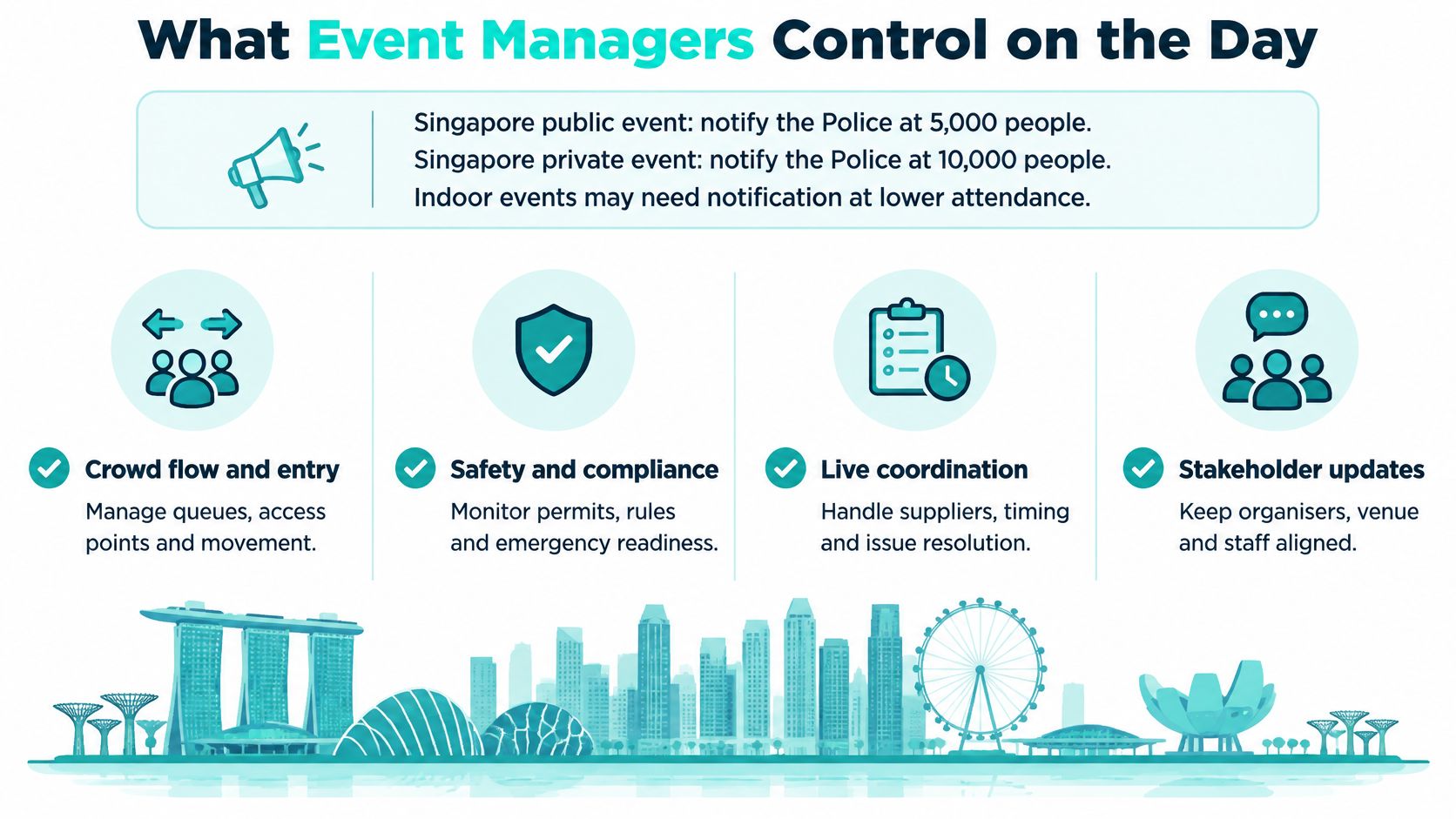
Singapore sets a clear line for when a gathering stops being a private timetable. Organisers must notify the Police when a public event is expected to attract at least 5,000 people, or a private event at least 10,000 people, as set out in the Ministry of Home Affairs reply on crowd-surge controls. Indoor venues carry their own occupancy and exit rules, which the organiser should confirm with the venue rather than assume. A school field or company carnival sits well under the police thresholds, yet the same logic applies at smaller scale. If you cannot count who is in a zone, you cannot keep the route clear.
That is why most school sports days, family days and carnivals are management-led, even when the booking looks like a simple planning job. The run sheet is usually fine. What fails is the floor.
Live controls that actually move
On the day, management is a short list run on a clock.
- Check-in and arrival flow: one entry, a visible queue, and a person who can stop a second wave walking in beside it.
- Headcounts per activity zone: compare the live number against the cap written for the site.
- Supervision of active zones: our staff oversee the games and keep safety protocols in place for the whole session, including inflatables, Kin-Ball and laser-tag style activities.
- Equipment checks between sessions: a quick inspection before the next group starts, rather than a hope that the last group left it fine.
- Timed programme checks: if a rotation slips, the next station hears about it before the queue forms.
- Incident logging and escalation: write it down, then call the venue contact or emergency services when required.
- Closeout: pack-down, a short note on what slipped, and the documents the client asked for.
Say a bubble soccer station runs ten minutes late. The queue bends into the walkway that the next house group needs. A manager pulls one facilitator to hold the line and shifts the rotation by one slot. Left alone, that bend becomes a trip hazard and a missed finish time. Multi-station formats, which we run as sports events in Singapore, fail in exactly this way when nobody owns the clock.
A well-managed event shows no uncontrolled crowding, no incident left unlogged, and a programme that finishes close to the run sheet. Games being "delivered" is not the benchmark. Controlled flow, capacity and a clear emergency path are.
Splitting Responsibilities Between Planner and Manager
When two parties share an event, most failures happen at the handoff. Write the split before anyone pays a deposit. A package that "includes everything" still needs a name next to each line, because our rental packages combine multiple games and equipment and can be customised by participant numbers and event duration. Custom also means the quote can hide an ownerless task.
The split itself moves with scale and risk. A single-station birthday is mostly a planning job, and the provider's crew absorbs the day-of calls. A school sports day or family carnival with several concurrent zones and outside vendors is management-led even when the booking looks simple, because live decisions outnumber design decisions once the first wave of participants arrives. My recommendation: once you pass three activity zones running at the same time, assign the manager role first and let the plan flex around it.
Singapore now expects environmental results to be planned, delivered and evidenced. The MICE sustainability framework became the first globally recognised GSTC framework for event organisers and venues in November 2024, according to the Singapore Tourism Board year-in-review release. Green sits inside the same split. The planner sets waste, reuse and supplier targets. The manager runs separation, reusable kit, consolidated transport and the post-event report. Both agree the metrics before booking.
| Handoff Item | Planner Owns | Manager Owns | Confirm Before Booking |
|---|---|---|---|
| Venue and space | Shortlist and approval | Capacity and zoning on site | Maximum players per zone |
| Equipment and transport | Quantities and budget | Delivery, setup and collection | Delivery window and venue access |
| Staffing ratio | Target ratio in the brief | Deploying and supervising crew | Headcount per activity zone |
| Safety and emergency | Emergency route in the plan | Incident logs and escalation | Named first-aider and contact person |
| Sustainability | Waste and reuse targets | Waste separation and data | Reporting format and metrics |
Ask for an itemised quote that names the owner of each line. Price follows the games, the headcount and the hours, so a lump sum without owners is a guess. Concert promotion checklists such as the Express Text promoter playbook assign load-in, crew and contingency in writing because nobody can renegotiate ownership once the show starts. The same discipline saves a family carnival.
Practical rule: any item without a named owner becomes the manager's risk on the day.
When You Need a Planner, a Manager or Both
The common assumption is that a planner always comes first and a manager only appears later. That sequence fits a single-station birthday. It does not fit most school, family day and carnival work in Singapore, where size, risk and the number of stakeholders move the boundary while you are still designing.
Events here have grown more complex. Corporate family days, school carnivals and community gatherings now pull in multiple vendors, mixed age groups and venues with their own rules on space, access and safety. Every extra party in one event is another handoff, and a handoff without a live owner is where a sound plan stalls. The tighter crowd and health controls of recent years pushed more work onto the live side, widening the gap between designing an event and running one.

| Event Type | Planning Need | Management Need | Best Setup |
|---|---|---|---|
| Private children's birthday party at a park or void deck | Theme, activity choice and timing | Light supervision and setup | Planner-led, with the provider handling setup and takedown |
| Corporate family day or team-bonding session | Objectives, budget and programme | Multi-station flow, facilitators and safety | Both, with one named owner for the timetable |
| School sports day | Curriculum fit, house groups and schedule | Rotating stations, headcounts and incident log | Management-led |
| Community carnival or mass group event | Concept, sponsorship and activity zoning | Crowd movement, vendors and weather plan | Both, with a dedicated operations lead |
Where the lead actually sits
A small private party stays planning-led once the activities are chosen, the slots are timed and the venue is confirmed. Setup and takedown still need a crew, but one owner can hold both hats. The remaining risk sits in the booking details.
Scale changes that. A school sports day, a corporate family day or a community carnival turns management-led as soon as you have several stations, mixed ages, crowd movement, weather contingencies, equipment changeovers or a safety escalation path. Each extra station adds a changeover, and each changeover is where queues form, equipment goes missing and younger participants drift. I would not hire a designer and assume the rotations will police themselves.
The planner still sets the objectives, the budget and the programme. The manager holds the headcount at each station, the changeover timing, the facilitator briefing and the call when weather or capacity cuts a zone. A rental provider becomes a management partner when it owns those live pieces, even if the school or the HR team still owns the overall event. Most Singapore school, family day and carnival events sit in this group, which is why they run management-led even when the job looks like simple planning on paper.
Count the stations, the age groups and the number of people moving at once. If two of those three are high, put a manager in the lead and keep the planner on the brief.
Brief Your Event Before You Book
Send one brief before you compare quotes. Include preferred games, event date, venue, estimated participants, age groups and duration. We review those requirements and issue a quotation from the selected games and the arrangements. Party packages include setup and takedown. The same path covers children's birthdays, mixed-age family events, school sports days, corporate family days and community carnivals. If you are shaping a company session, our guide on how to organise a sports team-building event in Singapore shows the questions worth settling before the quote.
Ask any provider three things. Who owns the timetable and the staffing ratio? Who holds the emergency route and the incident log? Which quote lines are customisable, and which change with the venue or the location? Venue and facility charges may apply, and activities depend on venue suitability and space. Then check the handoff rows. Every row needs an owner before you confirm the date.
We plan and run game rentals and on-site crews for Singapore birthday parties, school sports days, corporate family days and community carnivals, with the timetable, staffing and safety split written down before you book. That is the practical difference between event management and event planning when people are moving between stations. Visit ZOVB SG and send your games, date, venue and participant estimate so we can quote the arrangements.