Three requests land in the same week. One parent wants to know whether a bouncy castle will fit a condo function room for twelve seven-year-olds and two toddlers. A PE teacher is adding one more station to a sports day that already runs six. An HR lead is filling a family day for 400 staff and their children and needs a straight answer on what happens if a thunderstorm rolls in at 3pm.
All three are asking the same question underneath: which inflatable suits this event, on this ground, with this mix of ages, and at what point do we stop? Answer that and the theme, the colour and the price fall into place. Skip it and you're booking from a photo.
The stakes aren't abstract. The 2022 Active Healthy Kids Singapore Report Card found that only 44.4% of children and adolescents in Singapore met recommended physical-activity levels, as reported in the ActiveSG Circle family play resource. A castle that keeps children moving and rotating earns its place in a programme. One that leaves twenty children queuing while six bounce does rather less.
Table of Contents
- Match the Castle to Your Singapore Event
- Screen the Site Against BCA Size Rules
- Set Capacity and Supervision for Mixed Ages
- Plan Weather Stops and Backup Activities
- How to Book and Run the Rental
- Confirm the Booking Before You Pay
Match the Castle to Your Singapore Event
A bouncy castle works best as one station in an event plan, not as the whole programme. Start with the event and the people taking part, then check whether the venue can support the activity. The table helps turn a broad enquiry into practical details a supplier can assess.
| Event | Typical group | Site to confirm | Safer way to run it | Send with the enquiry |
|---|---|---|---|---|
| Birthday or playdate | About 8 to 20 children | Home, backyard, park or function room; check the available space and shade | Give toddlers separate turns and leave room for entry and exit | Date, ages, venue, duration |
| School sports day | Classes or CCA groups in rotation | School field, with drainage, power and clear overhead space | Use timed turns and run another activity alongside | Year levels, headcount, session length |
| Carnival or family day | Mixed ages and a large crowd | Open field, space around the activity, power and nearby shelter | Run parallel games to keep queues moving | Age bands, peak numbers, layout |
| Corporate team session | Adults, or adults with children | Firm, flat ground with delivery access | Check age and weight limits; organise separate turns for adults and children | Company size, indoor backup, timing |
A quote for a school field will differ from one for a function room. The available space, access and programme duration all affect what can be set up and how the activity fits into the event.
A birthday or playdate at home, in a park or in a function room
For a home party or playdate, the venue often sets the limits. A function room may have a low ceiling or noise rules. A park may need a booking and have uneven ground or drains that affect where the entrance can go. Birthday activities can also be held at a customer's home, backyard, nearby park or another venue of their choice.
The number of children is only part of the decision. Check the supplier's stated capacity, then consider the age mix and how turns will work. An advertised maximum is a limit, not a target, especially when toddlers are taking part. For other activity formats, birthday party ideas in Singapore can help you compare options before settling the layout.
A school sports day that needs one more station
A castle is one station in a sports day programme. Set a time limit for each class and keep another activity running alongside it, so pupils have somewhere to go while they wait. The 2024 Physical Education syllabus says pupils are expected to complete at least two recreational competitions or performances by the end of Primary 6. Do not assume that a particular inflatable station counts towards that requirement.
A carnival or family day where the crowd keeps arriving
For a large crowd, plan around how many people can take part at once and how quickly the queue can move. A family day can combine a castle with other activities, giving visitors alternatives instead of making one station carry the whole programme. ZOVB SG offers outdoor party and event rentals, including rentals for large-scale events such as product launches and family day carnivals. A family carnival package may include a selection of Zovb balls, giant beach balls and Tchoukball.
Clear signs can show where a queue starts and where participants leave the activity. If you need signs for an outdoor site or function room, KLM Design & Prints banner advice compares PVC and roller banners.
A corporate session with adults in the queue
Adult participation changes the checks you need to make. Ask for the activity's age and weight limits before booking, and confirm whether adults and children can take part safely in the same session. If they need separate turns, allow for that in the programme rather than deciding at the entrance.
Practical rule: if one activity cannot keep the queue moving, add a parallel station rather than crowding more participants onto it. A simple enquiry should include the headcount, age range, venue type and duration.
Screen the Site Against BCA Size Rules
Screening starts with measurements, not with the photograph. The checklist below is the version to keep on your phone while you're standing on the ground with the venue manager.
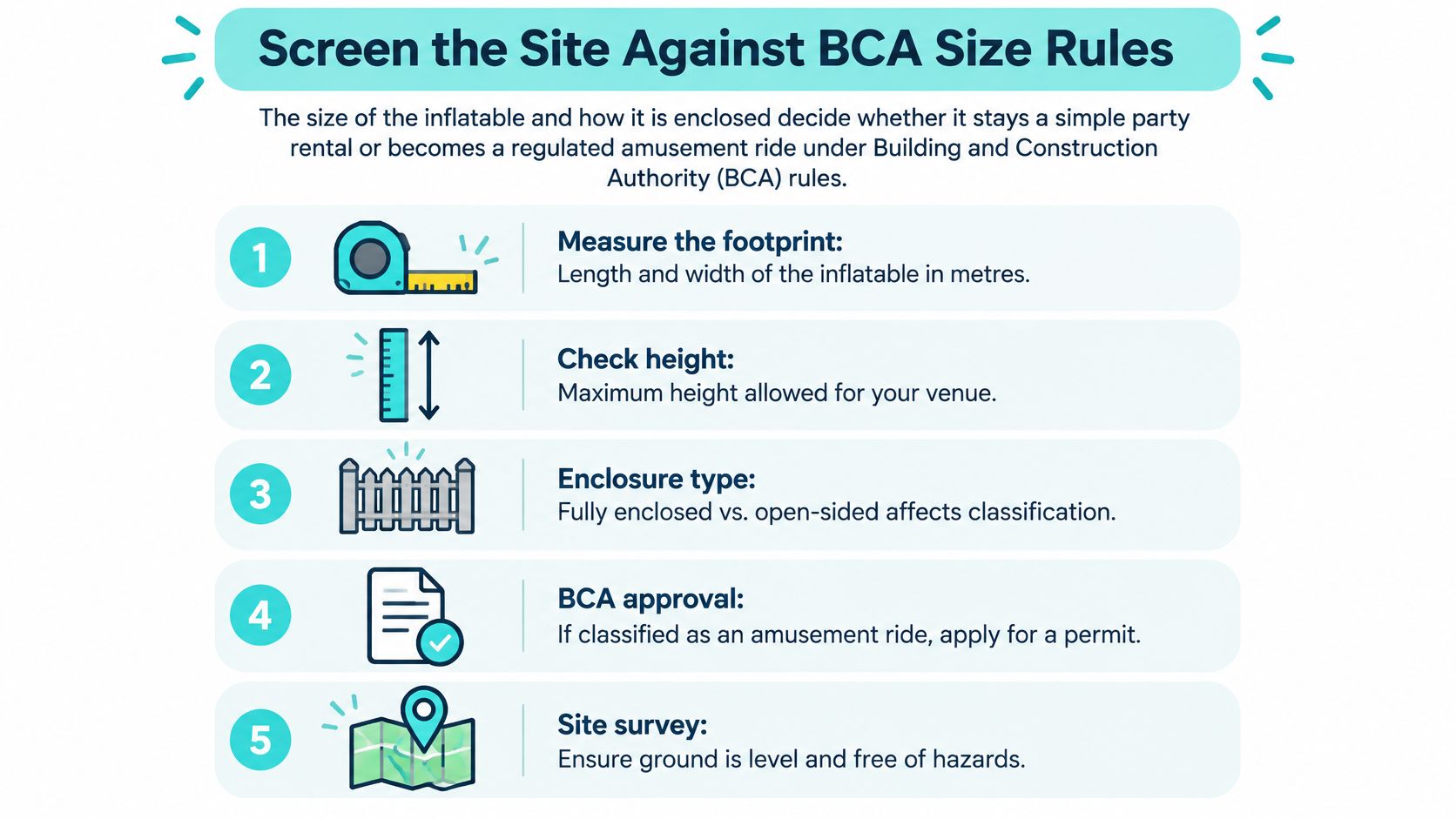
The size of the inflatable and how it's enclosed decide whether it stays a simple party rental or becomes a regulated amusement ride. Under the Building and Construction Authority's amusement ride safety requirements, a land-based inflatable is regulated when it has a projected base area of at least 150 square metres, a maximum vertical displacement of at least 5 metres, or, where it contains a fully or partly covered enclosed space, a base area of at least 30 square metres or a distance of at least 15 metres from the most remote point to the nearest exit. Units kept inflated by air blowers and several inflatables used together are also in scope, so the installation gets screened as a whole.
| Trigger | Threshold | What to do before booking |
|---|---|---|
| Projected base area | At least 150 m² | Ask whether the unit is a regulated amusement ride |
| Maximum vertical displacement | At least 5 m | Don't ignore height even if the footprint looks modest |
| Enclosed-space base area | At least 30 m² | Treat covered bounce houses as a separate check |
| Distance to the nearest exit | At least 15 m from the most remote point | Review the enclosure layout, not only the catalogue photo |
| Units kept inflated by blowers | Air-blower operation is in scope | Confirm power, blower condition and continuous inflation |
| Several inflatables together | The overall setup can count | Screen the whole installation, not one castle |
Four measurements to request before delivery
Ask for these in writing, in metres, and the screening stops being guesswork.
- The projected base area, length by width of the inflated footprint, not the packed size.
- The maximum inflated height, because a tall unit in a function room hits a sprinkler head.
- Whether any part is a covered enclosed space, which brings a much lower base-area threshold into play.
- The distance from the most remote point to the nearest exit inside the enclosure, and whether several units will run as one installation.
The site checks you can do yourself
No engineering background needed for any of these. Walk the ground for sharp objects and stones. Look at the slope and where water would pool after rain. Scan overhead for power lines, branches and signage. Check the cable route from the nearest power point to the blower and whether it crosses a walkway that children will use. Confirm the anchors have something to bite into, and mark a clear exclusion zone with cones or tape so waiting children aren't sitting against the wall of the castle.
If you're mapping the whole outdoor footprint, this outdoor event setup guide from MODERN LYFE covers power, shelter and pedestrian flow in more detail than a rental page will.
What to do when a trigger is met
If any threshold is met, ask the operator how the unit is regulated and what approval it holds before you pay a deposit. If the answer is vague or changes between calls, change the layout or choose a smaller unit. A small party castle under every threshold still needs every site check above.
If a supplier can't tell you the base area and the height in metres, that's your answer.
Set Capacity and Supervision for Mixed Ages
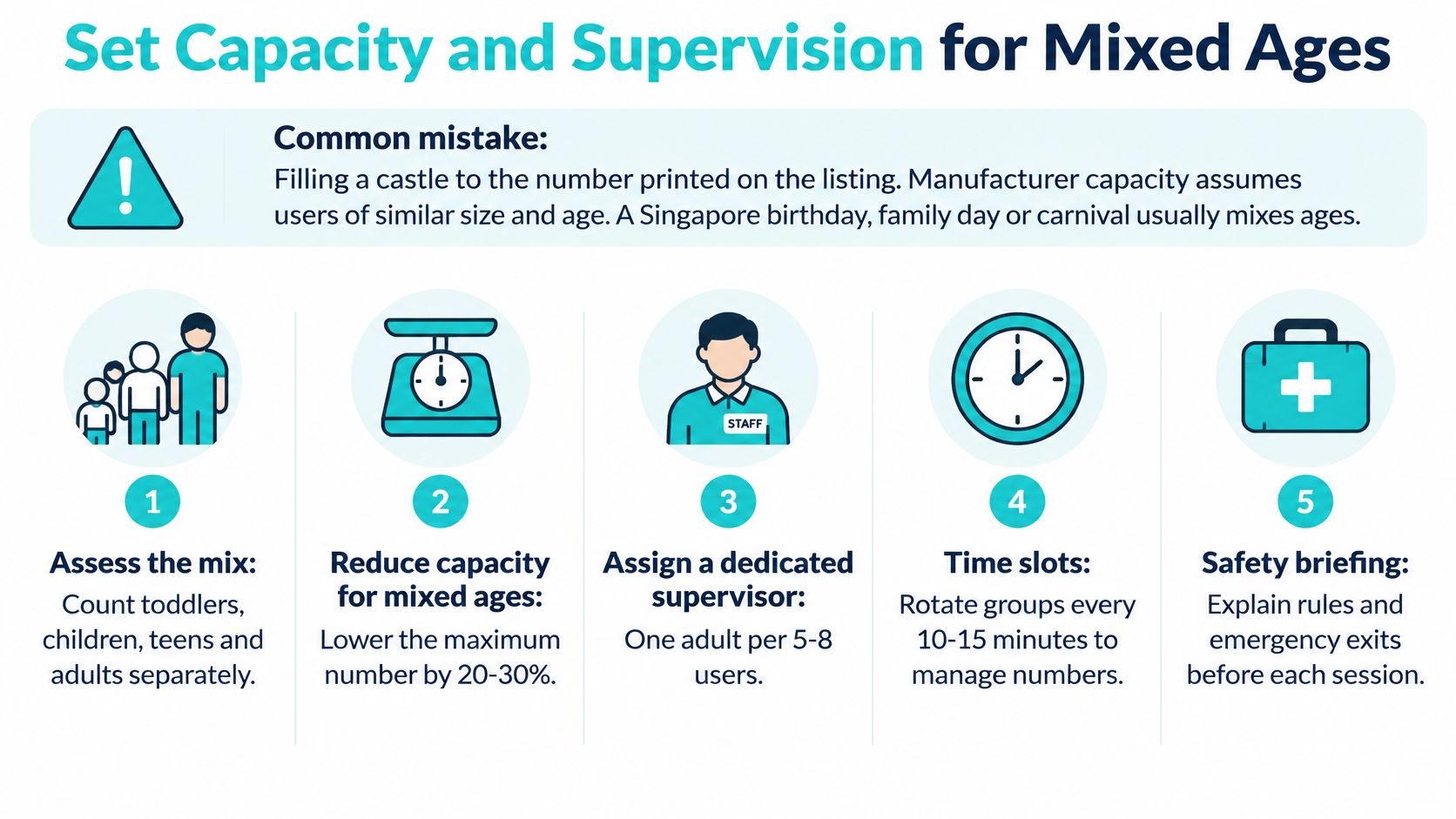
A listing that says "fits 20" is describing twenty users of the same size, taking turns in a steady rhythm. A real Singapore party serves a four-year-old, her nine-year-old cousin and a queue of schoolmates all at once, and that gap is where capacity planning earns its keep.
Set an operating capacity below the label
Work out your real number from three things: the age and weight gap between the youngest and oldest users, how many children will be bouncing rather than waiting at the mesh, and whether a named adult is free to watch with no other job. A toddler session of four is safer and more fun than a mixed session of sixteen.
Separate by size, not just by age. Toddlers get their own short turn, without older, heavier children landing beside them. Shoes, spectacles, watches and hard objects stay off the surface, and entry and exit run through one controlled point.
Use the regulatory floor for air-inflated enclosures
Singapore's rules for air-inflated enclosures give you a minimum standard to work from. The Amusement Rides Safety Regulations require a land-based enclosure to be directly supervised by an employee of the operator at all times, with one employee supervising no more than six air-inflated enclosures simultaneously. The unit needs sufficient air exchange whenever a patron changes, and users must declare pre-existing heart, lung or breathing conditions, which bar them from the enclosure entirely.
That six-to-one ratio matters the moment a carnival runs several inflatables at once. Six castles and one roving marshal is the legal ceiling, not a comfortable staffing plan for a crowd of children.
Watch for the everyday hazards
Any play equipment with ropes, seams and a bouncy floor sitting beside a concrete path needs an accompanying adult watching at all times. Entanglement in netting and falls onto hard ground are the injuries a supervisor is there to catch, so the adult at the entrance is doing safety work, not crowd control.
Short rounds also stack up into something worthwhile. HealthHub's Singapore Physical Activity Guidelines recommend that children and youths aged 7 to 17 average 60 minutes of moderate- to vigorous-intensity aerobic activity per day across the week. Ten-minute turns with a second game in between contribute to that better than one long queue.
Two named adults, two jobs: one controls the entrance and the queue, the other watches the bouncing surface for collisions, wall climbing and overcrowding. Neither of them is also holding the cake.
When the crowd is larger than one unit can take safely, add a second attraction and run shorter turns. Packing more children into the same castle is the one option that never works.
Plan Weather Stops and Backup Activities
A tent is not a thunderstorm plan. Each weather risk is a different problem with a different response, and lumping them together is how events get cancelled at 3pm with 200 children in the hall.
The Meteorological Service Singapore reports that inter-monsoon periods can bring thundery showers on most days, with afternoon storms sometimes extending into the evening, and temperatures that can reach about 35 degrees Celsius, according to Meteorological Service Singapore. That's a normal fortnight in Singapore, not an unlucky booking.
| Condition | Immediate action | Restart rule |
|---|---|---|
| Lightning or thunder | Evacuate at once to a proper shelter, not a canopy or the castle | No restart while thunder is audible; restart only after operator sign-off |
| Strong wind or moving anchors | Stop and deflate | Restart only after anchors and blower are rechecked |
| Rain that leaves the vinyl wet | Stop and keep users off the surface | Restart only when the surface is dry |
| Heat near 35 degrees Celsius | Schedule shade and water breaks; split bouncing into short rounds | Continue in rounds with shade breaks between them |
| Forecast cut-off | Check the forecast 90 minutes before start and again if the sky builds | Operator and organiser agree the decision in writing |
Name the roles before the day
Four jobs need names on them before anyone arrives: who calls the stop, who counts children off the castle, who tells parents what's happening, and who keeps the backup activity running while everyone waits. A stop call with no owner gets made twenty minutes too late, usually by three people at once.
Set a written cut-off and put it in the run sheet. A forecast check 90 minutes before the start time, plus a second look if the sky darkens, beats watching the radar and hoping.
Build a backup that doesn't need the castle
The backup has to work without the inflatable, or it isn't a backup. A short team game, a shaded challenge or an indoor hall activity you've cleared with the venue in advance all qualify. If your plan B needs to move under a roof, these indoor activities in Singapore give you options that don't depend on the weather.
Stop play, move everyone to shelter, and keep children supervised until an adult says otherwise. That sequence is the whole principle, and it works for a birthday in a park and a 500-person carnival alike.
Put three questions in the contract
Ask the rental company in writing, before the deposit:
- Does a storm mean postponement, a move indoors or a partial refund? Get the answer in the quotation, not in a phone call.
- How quickly is a stop call acted on? The crew on site needs authority to deflate without waiting for a manager.
- Who decides when play can restart? Name the person and the condition.
A castle under a tent still has to be evacuated when lightning is close, and the ground still has to be dry before anyone returns. Treat rain, wind and heat as separate problems and you'll rarely lose the whole programme.
How to Book and Run the Rental
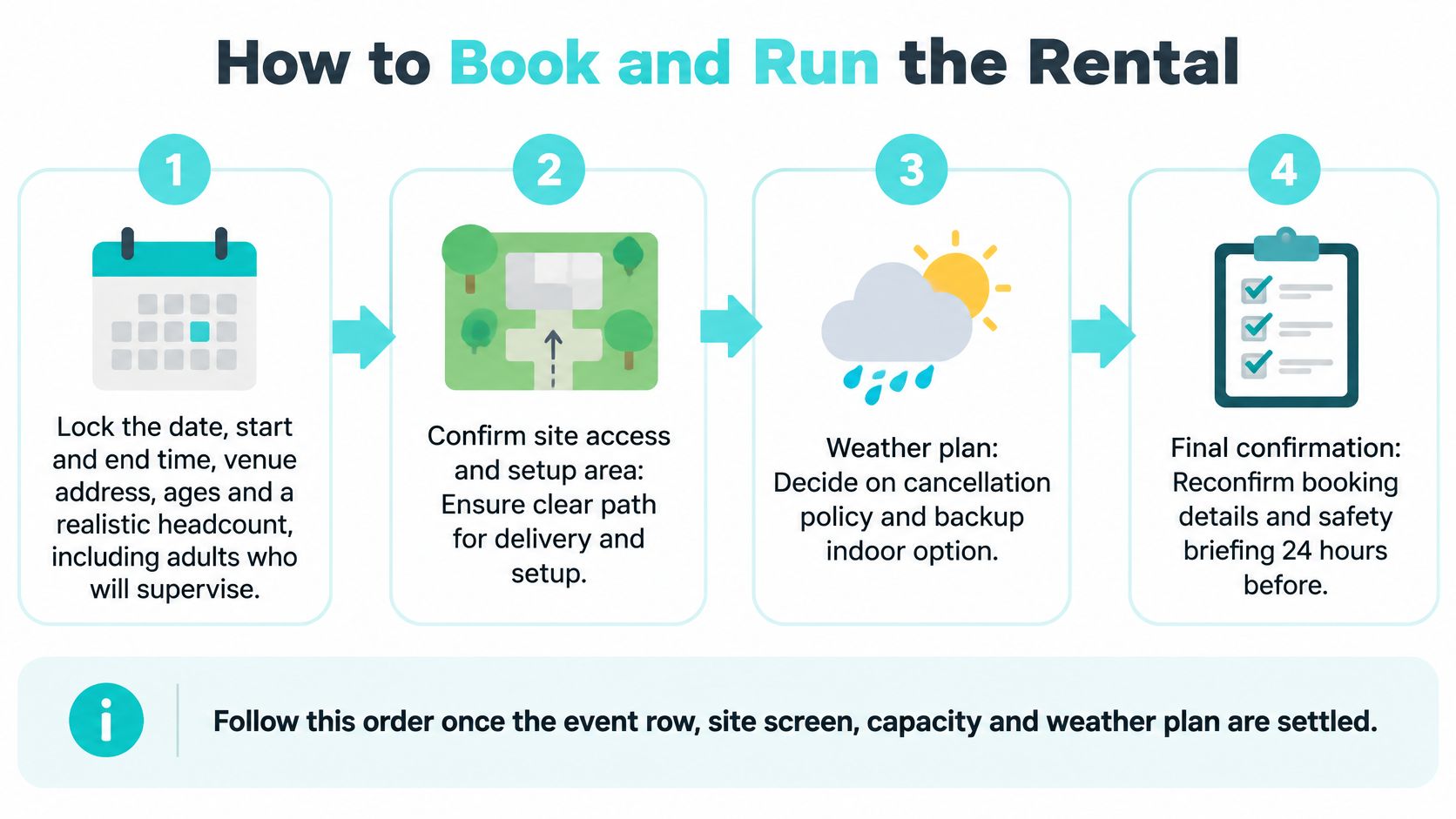
Booking comes last in the planning order for a reason. Each earlier check, the event fit, the site measurements, the capacity limit, the weather cut-off, feeds a line in the booking conversation, so by the time you call the operator you are handing over decisions rather than asking for them. Work through the sequence in this order and you'll avoid the mistakes that cost the most time on the day.
Lock the basics. Date, start and end time, venue address, ages and a realistic headcount, including the adults who might climb in. The common slip is booking without ages, then discovering the castle suits under-tens when half the guest list is thirteen.
Measure the ground and the access. Flat area, overhead clearance, distance to a power point and the route a delivery vehicle can take. Confirm whether the venue or the park authority requires its own approval for an inflatable. The common slip is assuming a park booking slot is the same thing as permission.
Send measurements, not just the catalogue photo. Include the figures from your site screen and ask whether the unit, alone or with others, meets any BCA threshold. A photo tells the supplier nothing about the ground.
Agree an operating capacity and name the supervisors. One person on the entrance, one on the bouncing surface. Leaving parents as the only supervisors means nobody is watching.
Set the stop conditions and one non-inflatable backup. Skip the backup and a single storm wipes out the programme.
Confirm what arrives. Blower, mats, anchors, crew numbers, and whether setup and takedown are included. Quotes vary with delivery distance, mat and blower count, crew size and session length. The common slip is comparing two quotes that include different crew sizes.
Walk the ground on the day. Clear it before inflation, keep shoes and hard objects off, and stop when wind, lightning or a slippery surface appears. In Singapore heat, press a palm on the vinyl before play starts; a surface too hot for bare feet is a stop condition too. Restart only after a dry surface check and the operator's sign-off.
Close out properly. Clear every user before deflation and check the area before the crew leaves. A half-collapsed castle still attracts children, so keep the entrance manned until the unit is flat.
Compare like with like: two quotes only compare when the crew size, mat count and session length match.
Underpinning all eight steps is a duty, not a preference. Singapore's regulatory framework requires operators to take all reasonable steps and exercise due diligence so that operation doesn't endanger users, operators or nearby persons, as stated in the Amusement Rides Safety Act. Diligence here means documented pre-use inspections and a supervisor checklist, not a verbal handover.
Since no public scorecard rates rental operators, judge yours by the records they keep. Ask how they log pre-use inspections, incidents and near-misses per event, and whether each corrective action was closed. An operator who tracks those numbers can answer for them; one who can't is asking you to take safety on trust.
Pack-down is also when waste peaks, and this guide to managing waste and disposables on-site covers the clearing routine a carnival with food stalls will need.
Confirm the Booking Before You Pay
Pay when four points are in writing, and not before.
- The event row you chose, with headcount and age range attached to it.
- The site answer, meaning your measurements and whatever the operator says about classification.
- The operating capacity and the named supervisors, including who holds the entrance and who watches the surface.
- The weather cut-off and the non-inflatable backup, with the person who calls it and what happens to the fee.
Ask the operator to restate all four in the quotation alongside the unit, session times, site rules and cancellation terms. A verbal yes on weather is worth very little in a claims conversation.
Where the castle sits in the plan
Birthday party activities can run at the customer's home, a backyard, a nearby park or another venue of your choice, and additional venue or facility charges may apply depending on the activity and location. Ask about those early, before you fix a budget, because a function room booking fee can rival the rental cost.
If the castle can't carry the whole programme, add a second station rather than a bigger crowd on one unit. For carnivals and family days, we rent giant beach balls, Kin-Ball sets and Tchoukball equipment that run alongside an inflatable and keep the queue short, and birthday party game rentals covers the child-focused formats if you're building the rest of the day around younger guests.
Our birthday party packages include trainers and transport, and setup and takedown are included too, so the crew question resolves early for a home party. What stays with you is the age mix, the headcount and the supervisor rota.
The deposit test: if a supplier won't put the stop conditions and the crew numbers in the quotation, the cheapest price isn't the cheapest booking.
For school sports days and corporate team sessions, lean on cooperative stations so older pupils or staff stay active while younger children take a separate supervised turn. Send the date, venue, ages and headcount, ask for written weather and setup terms, and confirm the final age mix, headcount and layout in writing before the deposit. Keep the cut-off plan with the quotation on the day, because that's the page you'll be reading when the sky turns grey.
ZOVB SG supplies inflatable attractions, sphere games and team sports equipment for birthday parties, school sports days, corporate family days and community carnivals across Singapore, with trainers, transport, setup and takedown built into party packages. Send us your date, venue, age range and headcount, and we'll come back with a quotation that puts the weather and setup terms in writing alongside the price. Start at ZOVB SG, pick the station that fits your event, and let the castle be one part of a programme rather than the whole plan.