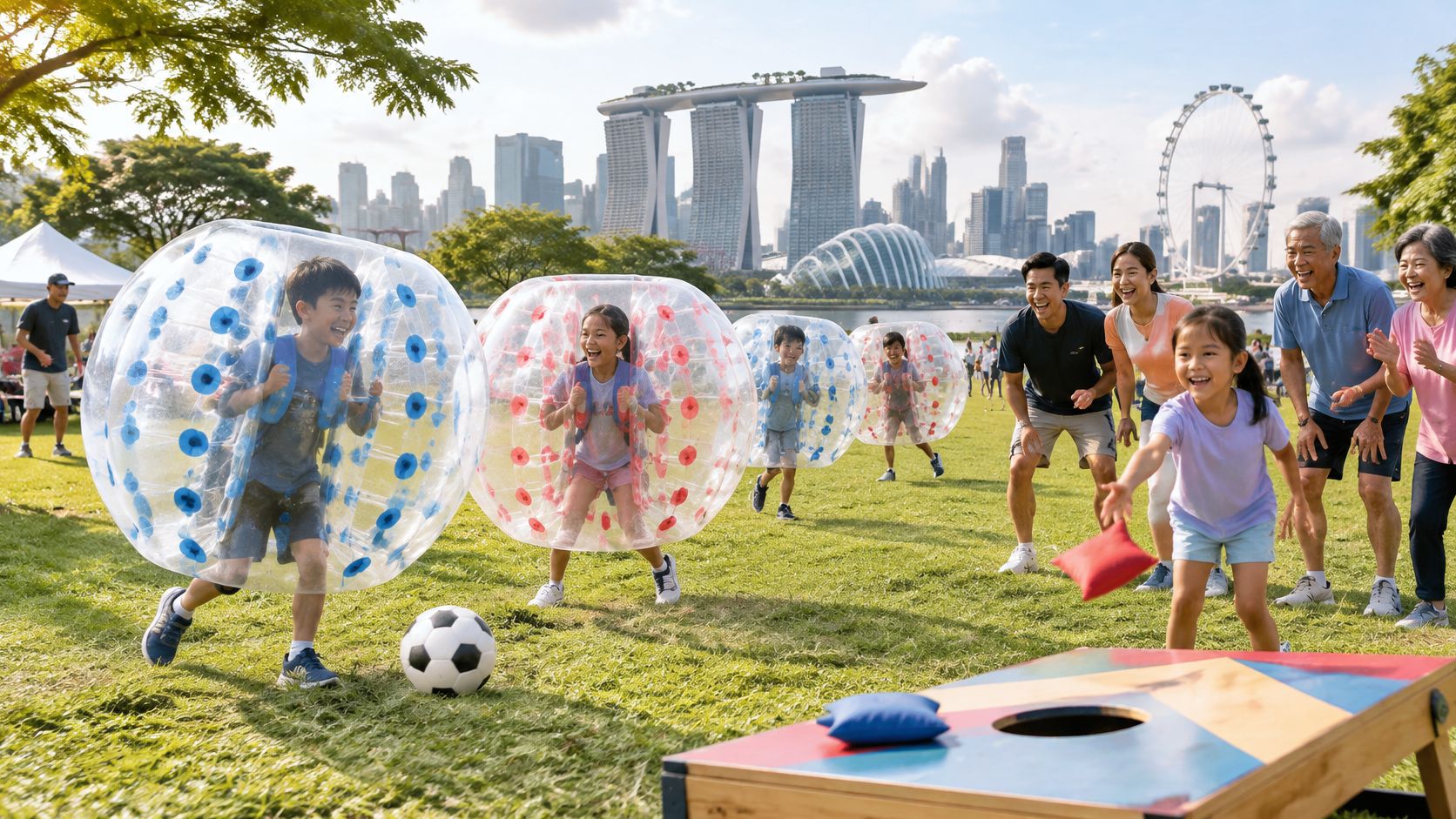
You've got a venue booked, a date circled, and a guest list covering a four-year-old, two teenagers, a colleague who runs marathons and a grandmother who will happily watch from a chair. Then someone asks what everyone is going to do. Most Singapore family days stall right there. One headline attraction cannot carry a group that mixed.
Match activities to the event before you match them to the crowd. A carnival needs stations that reset in seconds. A school sports day needs rotations that move whole classes safely. A corporate family day needs games where a manager and a primary-schooler can share a team without anyone feeling patronised. An outdoor kids' party needs something that survives a 3pm downpour.
Logistics get easier when the games come to you. ZOVB SG brings its games and equipment to your chosen location, so guests never have to travel to a dedicated activity venue. Shade, seating and water points still deserve as much attention as the headline game, a balance that fixed attractions like the one behind the Suan Luang sanctuary updates have to plan for every day.
The ten family friendly activities below run from Bloop Bubble Soccer to Cornhole Toss. Each is judged on the event it suits, how it handles mixed ages and how it copes with the humidity, with the trade-offs stated plainly. That includes the games I'd skip for certain crowds.
Table of Contents
- 1. Bloop Bubble Soccer for Family Days and Team Bonding
- 2. Giant Beach Ball Games for Mixed-Age Groups
- 3. Water ZOVB and Water Tag for Hot-Weather Events
- 4. Floorball Team Sessions for Schools and Corporate Groups
- 5. Kin-Ball for Cooperative Group Play
- 6. Spikeball for Quick Group Competitions
- 7. Tchoukball for Inclusive Team Sports
- 8. Cornhole Toss for Relaxed Group Competition
- 9. Combat Skirmish Laser Tag for Team Challenges
- 10. Community Carnivals and Corporate Family Days with Integrated Game Stations
- Family Friendly Activities Compared at a Glance
- Build a Mixed-Age Lineup Before You Book
1. Bloop Bubble Soccer for Family Days and Team Bonding
Bubble soccer is football where every player wears an inflatable, fully enclosed bubble suit. You bounce, you tumble, you push. Football skill barely matters. Balance and willingness matter more, which is exactly why it levels a group of teenagers, parents and colleagues.
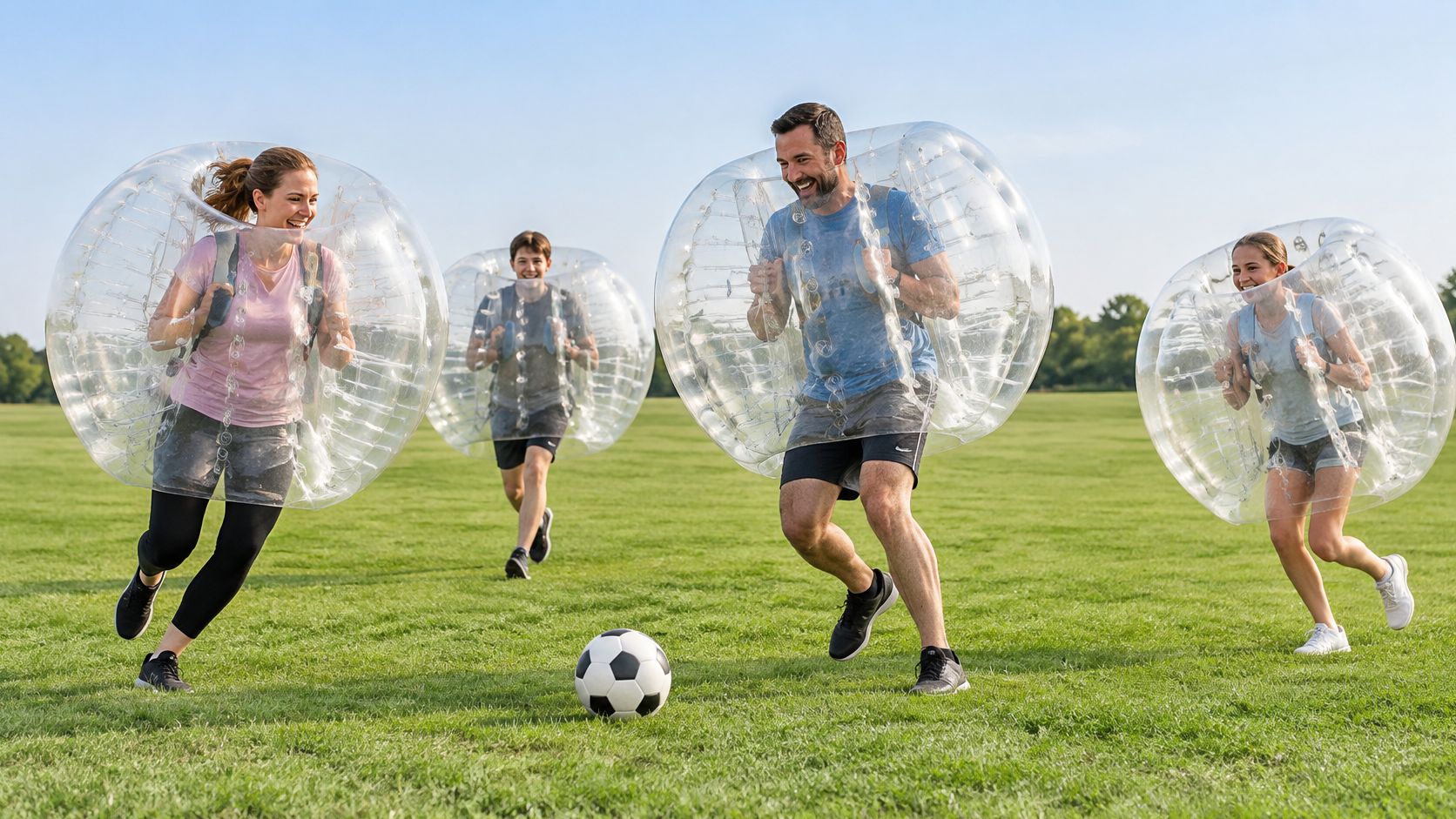
It's a contact game, so treat it as a managed activity, not a free-for-all. Sport Singapore's sport safety framework points to Singapore Standard SS 681:2022, the Code of Practice for Sport Safety, which pushes organisers towards proactive risk management. In practice that means checking the field for glass, roots and drain covers before anyone suits up.
Where it earns its place
- Corporate family days: mixed-department tournaments where the bubble does the equalising.
- School sports days: short class-versus-class matches on a rotation.
- Older kids' birthdays: park or open-venue parties for children and teens who want to collide with something.
Heat is the main limiter. The suit traps warmth, so run matches of eight to ten minutes with proper rest gaps, schedule them early morning or late afternoon, and keep drinking water and shade at the pitch edge. Tell us your field size and headcount when you enquire, because every booking depends on venue suitability, space and availability.
2. Giant Beach Ball Games for Mixed-Age Groups
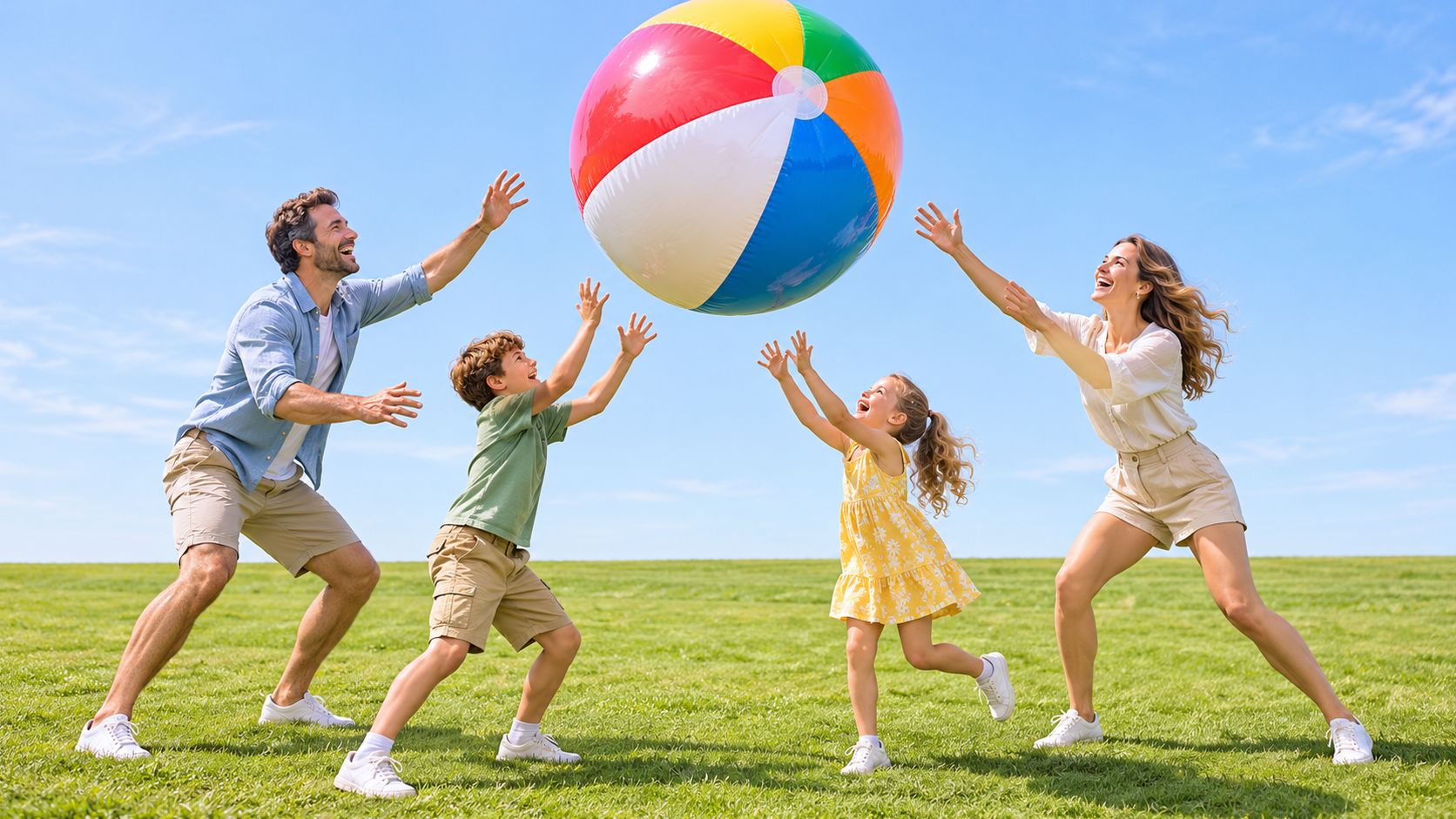
Start here if your guest list is all ages. Giant beach balls are oversized, lightweight inflatables that groups keep airborne, pass along a line, or push towards a target. Nobody needs instruction beyond "don't let it drop".
The reason this works is that family park use isn't mostly sport. An academic assessment of Bishan-Ang Mo Kio Park, published in Sport Singapore's sport and exercise participation facilities insights, found about 35% of visitors were people with children, with activity split across exercise, recreation and social time. A giant ball sits comfortably in all three.
The best opening game is the one a grandparent can play standing still and a toddler can play by accident.
A worked example. Say a community carnival opens at 9am with families trickling in. Run three-minute keep-it-up rounds with mixed family teams, announce each start time clearly, and you've warmed the crowd up before the heavier stations open. The same format works as a pre-party icebreaker at a children's birthday while late guests arrive.
Two practical cautions. Wind takes an oversized ball seriously, so pick a sheltered court or a spot screened by buildings rather than an open field. And keep rounds short with a visible timer, because the novelty fades faster than you'd expect. Pair it with a heavier attraction later and it does its job perfectly.
3. Water ZOVB and Water Tag for Hot-Weather Events
Water games are the honest answer to a Singapore afternoon. Water ZOVB and Water Tag combine running, dodging and splashing, and they pull a crowd in a way dry games don't when the sun's at full strength.
They also carry the most supervision burden of anything on this list. Sport Singapore's safety resources for organisers name heat-injury prevention and water safety as core topics, alongside recognising warning signs and responding to incidents. Translate that into a named spotter per zone, a hard boundary line for younger children, and a stop rule when lightning is nearby.
What to sort out before you confirm
- Venue permission: many parks and condo lawns don't allow water play. Confirm in writing first.
- Guest kit: tell everyone to bring a change of clothes, a towel and sunscreen. Put it in the invite, not a follow-up message.
- Surface and drainage: wet tiles turn a running game into a slip risk. Grass or a textured wet-play surface is safer.
- Shade and hydration: a shaded rest area within a few metres, not across the field.
Schedule water stations in the midday heat window, when your dry games would sit empty anyway. For a school sports day, that's the slot after lunch. For an outdoor birthday party, it's the reason parents stay instead of leaving early.
4. Floorball Team Sessions for Schools and Corporate Groups
Floorball is the most underrated school and corporate option in Singapore. Lightweight plastic sticks, a perforated plastic ball, fast indoor play. It came out of Sweden and Finland in the 1970s and now travels internationally, and the equipment cost stays low enough to run several courts at once.
Schools carry a specific duty here. The Ministry of Education's parliamentary reply on outdoor education and activities states that schools conduct risk assessments covering facilities and equipment, personnel competence, safe conduct, participant readiness and the environment, and that external vendors must comply with MOE safety guidelines while school staff monitor student well-being. Document your checks. It's not paperwork for its own sake, it's how a coordinator proves the day was planned.
Where it fits best:
- School sports days: year-level rotations on half courts, so a class of forty isn't standing around.
- Corporate team bonding: short department matches during a lunch hour or an off-site afternoon.
- Youth groups: an easy first team sport for beginners.
Run a two-minute skills demo before the first whistle: how to hold the stick, no high sticks, no pushing. Mix experienced players across teams rather than letting one department stack itself. Because it's indoors, floorball is also your wet-weather anchor. When rain kills the field programme, the hall session still runs, and school groups can ask us about special rental rates for camps and CCA or leadership training programmes.
5. Kin-Ball for Cooperative Group Play
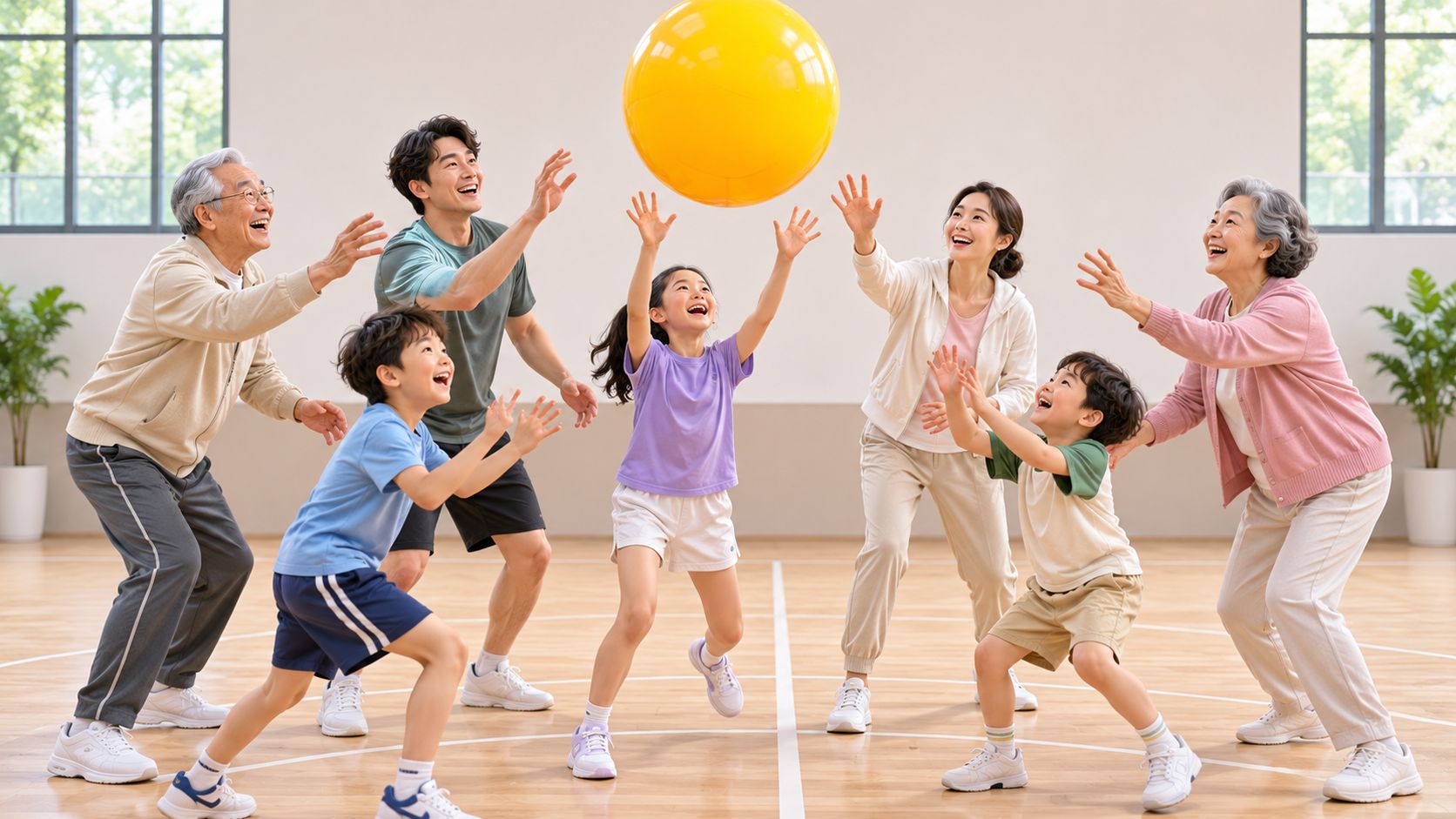
Kin-Ball uses a huge, brightly coloured ball roughly three feet across, and teams work together to keep it off the ground. Created in Canada in the 1980s, it was designed to reward communication rather than individual athleticism. That design choice is why it handles mixed-ability groups better than almost any conventional ball game.
Segmentation matters when your audience spans ages. Sport Singapore's National Sport and Exercise Participation Survey collects continuously from residents aged 13 and above with annual samples of at least 4,500 respondents, weighted to the population, and reports regular, occasional and non-participants separately. Plan for all three, not just the regulars.
Practical rule: build an easy entry plus an escalation. Kin-Ball is the entry. A competitive bracket later is the escalation.
A corporate family day is the ideal setting: teams of employees plus their kids, where the ball's size cancels out fitness differences. It also works as a mid-event feature game, the one thing everyone gathers around at 11am. For a fuller picture of how it sits alongside other formats, our guide to multi-sport team bonding with Kin-Ball, Bloop soccer, Tchoukball, floorball and Spikeball shows how the games combine.
Demo the rules first, rotate players often, and balance teams by age and fitness. Skip the long explanation. Two practice rallies teach more than five minutes of talking.
6. Spikeball for Quick Group Competitions
Four players, two teams, one small circular net. Spikeball bounces a ball off the trampoline-like surface and asks the other pair to return it. Rounds are short, the setup fits a corner of a courtyard, and the rules take about a minute to explain.
This is a teenagers-and-adults game, and I'd be direct about that. Younger children struggle with the hand-eye timing and the diving returns, so don't build a whole under-eight party around it. Use it as one station among several, with a calmer option next door.
A typical corporate use. Say a company runs a Friday lunch social with sixty staff. Set up four to six nets in one area, run a knockout bracket with three-point rounds, and you've got continuous play with no long queues. A casual work social can just as easily be a game of Bloop bubble soccer followed by drinks nearby, with Spikeball as the low-commitment option for people who'd rather not suit up.
Practical points that decide whether it works:
- Net count: one net serves four players at a time. Do that arithmetic against your headcount before booking.
- Surface: grass or a sports hall floor, not rough concrete that scuffs knees.
- Progression: a visible bracket sheet keeps people coming back for the next round.
- Pairing: run it beside a throwing or tossing station so waiting players have somewhere to go.
We customise team programmes around age and physical capability, so tell us the spread of your group and we'll size the bracket accordingly.
7. Tchoukball for Inclusive Team Sports
A school coordinator with a mixed class, a few parents and a helper who needs to stay seated can still run a proper team game with Tchoukball. Players throw at a rebound net and try to make the ball bounce back where the opposition cannot catch it. The game is non-contact, so it removes the collision risk that puts some parents off and gives quieter participants a real role. Its origins are generally tied to reducing injury and emphasising fair play, and that intent shows in how it plays.
For a carnival or community sports day, treat Tchoukball as the inclusive station beside higher-energy games. For a school sports day, it works well when classmates of different abilities share a team. For a corporate family day, it gives adults and children a common task without turning the session into a contact game. Humidity matters here. Keep the waiting group in shade, rotate often and have water within reach.
Designing for different needs
Inclusion is not only about wheelchair ramps. The Early Childhood Development Agency's Let's Go Wild guidance describes nature experiences for children of all abilities and notes that universal design can include sensory play, accessible play equipment and designated spaces for mobility aids. Apply the same thinking to a game station.
- Adapted roles: a child who dislikes noise or contact can be the designated thrower from a fixed spot.
- Shorter rounds: two-minute halves let anyone step out and back in without disrupting a team.
- Visual briefing: demonstrate the rebound angle rather than explaining it. Show one throw, then let them try.
- Clear rest zone: a shaded chair with sightlines to the court, so sitting out doesn't mean missing out.
Tchoukball suits school PE sessions, corporate courts and community sports days where you need a safe option. Siblings of different abilities can play on the same team here. State the physical requirements plainly when you brief guests. Overstating suitability helps nobody.
8. Cornhole Toss for Relaxed Group Competition
Not everyone wants to run. Cornhole Toss is the traditional American lawn game where you throw bean bags at a raised board with a hole, scoring for bags on the board and in the hole. It's the station that keeps parents, older relatives and the mildly competitive colleague happy for two hours.
Its real value is social. People talk while they throw. Conversations happen between rounds. At a corporate family day, that's where colleagues get to know each other, and it costs you almost nothing in supervision or briefing time.
Placement decides everything. Put the boards in shade, on flat ground, with a clear throwing lane and a marked line for younger children to throw from. A board sitting in full afternoon sun will be abandoned by 2pm regardless of how popular it was at 10am.
A simple setup that works:
- Multiple boards: two to four boards keep several groups playing at once instead of queueing.
- Short bracket: first to eleven, single elimination, names on a whiteboard.
- Family pairing: one adult, one child per team, with the child throwing from a closer mark.
- Contrast programming: run it beside your highest-energy attraction so guests can alternate.
For a birthday party on a lawn, Cornhole is the game adults join without being asked. For a carnival, it's your calm counterweight. I'd never build an entire event around it, but I'd rarely build one without it.
9. Combat Skirmish Laser Tag for Team Challenges
Laser tag delivers the thing team bonding sessions usually lack: a reason to talk to each other under pressure. Players wear sensor vests and use light-based blasters to tag opponents and complete missions across a defined arena. Commercial arenas took off in the 1980s and the format has stayed popular because strategy and excitement arrive together.
It's strongest with teens and adults. Corporate teams get genuine tactical communication, not an icebreaker nobody believes in. Teenage birthday parties get competition without contact injuries. Youth events get a headline activity that anchors the whole schedule.
Brief every player before the first round, without exception. Late arrivals get briefed separately, not waved into a live game.
How to run it well:
- Short rounds, several of them: three or four rounds of a few minutes each beats one long game. Energy stays high and eliminations don't leave anyone idle for long.
- Balanced teams: split by age and confidence, not by friendship groups.
- Mission variety: capture objectives or escort missions pull in players who aren't fast runners.
- Arena clarity: confirm arena size and participant numbers with your requirements, since space and availability shape what's possible.
Our breakdown of team building games for teens covers how to structure rounds so older and younger players stay engaged in the same session. Pair laser tag with a dry court game and you've got a full afternoon that alternates intensity instead of exhausting everyone by 3pm.
10. Community Carnivals and Corporate Family Days with Integrated Game Stations
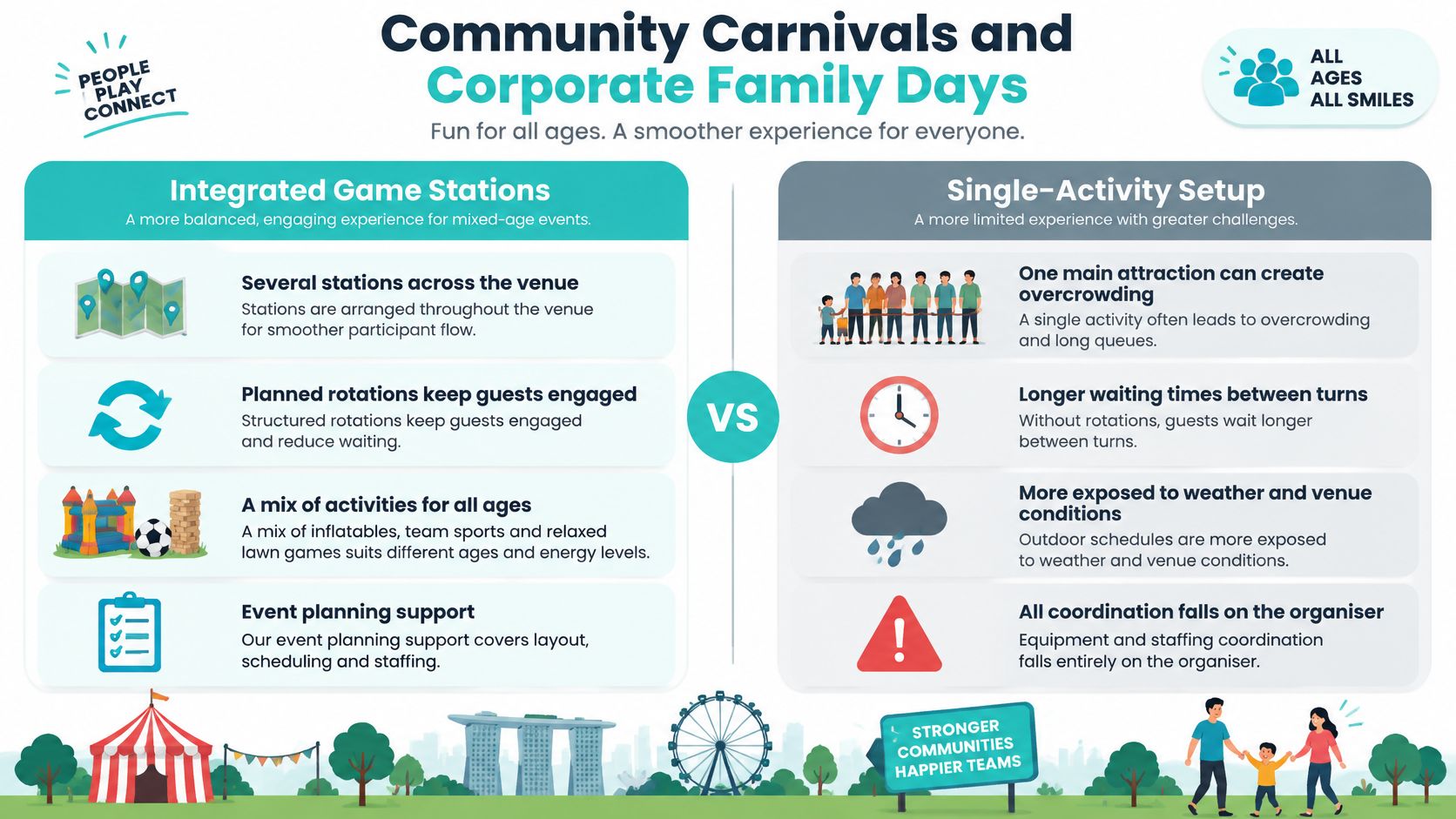
A hundred guests spread across a field is easy. A hundred guests queuing at one attraction is a complaint. Flow decides whether a large event works, so the design question is how many stations run at once and in what order people move between them.
Neighbourhood venues make this easier than organisers assume. The Urban Redevelopment Authority's Master Plan 2025 playful spaces theme sets a long-term aim for 8 in 10 households to live within a 10-minute walk of tranquil green spaces, sports and wellness facilities, and lively social spaces. You rarely need a destination venue. You need a nearby park and a sensible layout.
Shelter matters as much as space in Singapore's heat. The Building and Construction Authority's Universal Design Excellence Award recognises sheltered walkways, indoor respite areas and heat-mitigating design, which is exactly what to look for when scouting a site.
Building the sequence
- Map the layout first: stations, queue space, shade, a water point, a wet zone and a dry zone.
- Alternate intensity: a high-energy game, then a calm station, then a high-energy game again.
- Name station staff: one person per station guiding participants and watching safety.
- Write the rain plan: which games move under shelter, which pause, and who makes the call.
A family carnival package might pair Zovb balls with giant beach balls and Tchoukball so kids, parents and grandparents each find a station that suits them. ZOVB plans company family day carnivals and CSR Give Back events alongside rentals for large-scale events such as product launches, and our family day planning guide for Singapore walks through the format. If a sponsor or community partner asks how turnout went, be careful what a check-in tally proves: the argument behind why scan counts mislead marketers applies here too, since a count of arrivals tells you little about who played.
Family Friendly Activities Compared at a Glance
| Item | Best For | Setting | Key Constraint |
|---|---|---|---|
| Bloop Bubble Soccer for Family Days and Team Bonding | Mixed-age groups and team bonding | Flat, open fields | Heat, space and safety briefing needs |
| Giant Beach Ball Games for Mixed-Age Groups | Inclusive icebreakers and family play | Indoor halls, lawns or beach-style areas | Wind can affect outdoor play |
| Water ZOVB and Water Tag for Hot-Weather Events | Active play in hot weather | Outdoor areas with water access and drainage | Requires water, cleanup and changing facilities |
| Floorball Team Sessions for Schools and Corporate Groups | School and corporate team sessions | Indoor courts or sports halls | Needs suitable court space and enough players |
| Kin-Ball for Cooperative Group Play | Cooperative play across ages and abilities | Large indoor or outdoor areas | Requires space and a rules briefing |
| Spikeball for Quick Group Competitions | Quick, small-group competitions | Compact indoor or outdoor areas | Only four players per net at a time |
| Tchoukball for Inclusive Team Sports | Safe, inclusive team play | Indoor sports halls or courts | Requires rebound nets and a rules briefing |
| Cornhole Toss for Relaxed Group Competition | Relaxed social play for all ages | Lawns, outdoor areas or indoor halls | Low-energy format; limited boards can cause waits |
| Combat Skirmish Laser Tag for Team Challenges | Tactical team challenges for older children and adults | Defined indoor or sheltered outdoor arena | Requires controlled arena space and safety rules |
| Community Carnivals and Corporate Family Days with Integrated Game Stations | Large mixed-age events | Venues with space for multiple activity stations | Requires careful scheduling, staffing and coordination |
Build a Mixed-Age Lineup Before You Book
Start with the event type, then pick two high-energy games, one team game and one relaxed station. That combination gives every age group a role, and it gives you a schedule that alternates effort instead of stacking it.
Household variety is the reason this matters. Singapore's 2020 Census of Population recorded 1.37 million resident households, with 78.0% containing at least one family nucleus, while couple-based households with children made up 47.7% of resident households, down from 56.0% in 2010. Your guest list won't be one neat profile. Grandparents, single parents, teenagers and childless colleagues will all be in the same field, and the lineup has to work for them together.
A practical build for a corporate family day: Bloop Bubble Soccer and Water Tag as the high-energy pair, Kin-Ball or Tchoukball as the team game, Cornhole Toss as the calm station. For a school sports day, swap water play for floorball rotations in the hall so rain doesn't cancel your afternoon. For an outdoor kids' party, giant beach balls open, one headline game follows, and a tossing station keeps parents involved.
Then handle the logistics early. Send your event date, venue, participant count and chosen activities when you request a quotation, and confirm space and venue suitability before you commit to a game. Every activity depends on the venue, the footprint available and availability on the day, so a photo of the field or hall is worth more than a description. Popular spots such as Kovan Sports Centre and The Cage @ Kallang book out, and venue or facility charges can apply depending on the activity and location.
We bring the games and equipment directly to your chosen location, so guests don't travel to a specialist venue, and you can combine different activities at one birthday party by sending us your requirements. If you're weighing whether an off-site format suits your team better, these corporate team paddling itineraries show a different way to structure a group day out.
ZOVB SG rents Bloop Bubble Soccer, Water ZOVB, Water Tag, Kin-Ball, Tchoukball, floorball equipment, Spikeball, Cornhole Toss, Giant Beach Ball and Combat Skirmish Laser Tag, and plans school sports days, corporate family days and community carnivals across Singapore. Tell us your date, venue, headcount and the mix of ages you're expecting, and we'll shape a lineup that keeps everyone playing rather than watching. Visit ZOVB SG to browse the games and send your event requirements for a quotation.