Saturday afternoon. Six excited four-year-olds, a shady corner of the void deck or a grassy patch at the nearby park, and you need every child busy without anyone melting down. The right birthday party games for 4 year olds depend on how many children showed up, how much energy they still have, and where you are standing. You can host at home, in a backyard, at a nearby park, or at another venue you choose.
This guide sorts eight games by group size and energy level, not by a vague ranking. A parent with six children at a playdate should not get the same plan as an organiser booking a park party for thirty, a school sports day, or a company family carnival. Each game says who it suits, how hard the children will run, what to watch, and how a real setup looks.
Four-year-olds can follow one clear instruction and take a short turn. They still differ in coordination, confidence, and stamina. Skip elimination, give a watching child a helper job, and alternate a lively round with water and a quieter station. Neighbourhood parks, condo lawns, and void decks all work when the game can shrink. Build the afternoon from calm to lively.
You don't need a long checklist. Match the crowd, then pick the energy.
Table of Contents
- 1. Giant Beach Ball Circle Play
- 2. Bloop Bubble Soccer (Junior Session)
- 3. Land ZOVB Bowling with Oversized Pins
- 4. Cornhole Toss for Preschoolers
- 5. Kin Ball Team Circle
- 6. Water Tag Summer Splash Game
- 7. Mini Floorball Stick and Ball Game
- 8. Junior Tchoukball Catch and Rebound
- How the eight four-year-old party games compare by group size, energy and setting
- Matching the Right Game to Your Crowd and Energy
1. Giant Beach Ball Circle Play
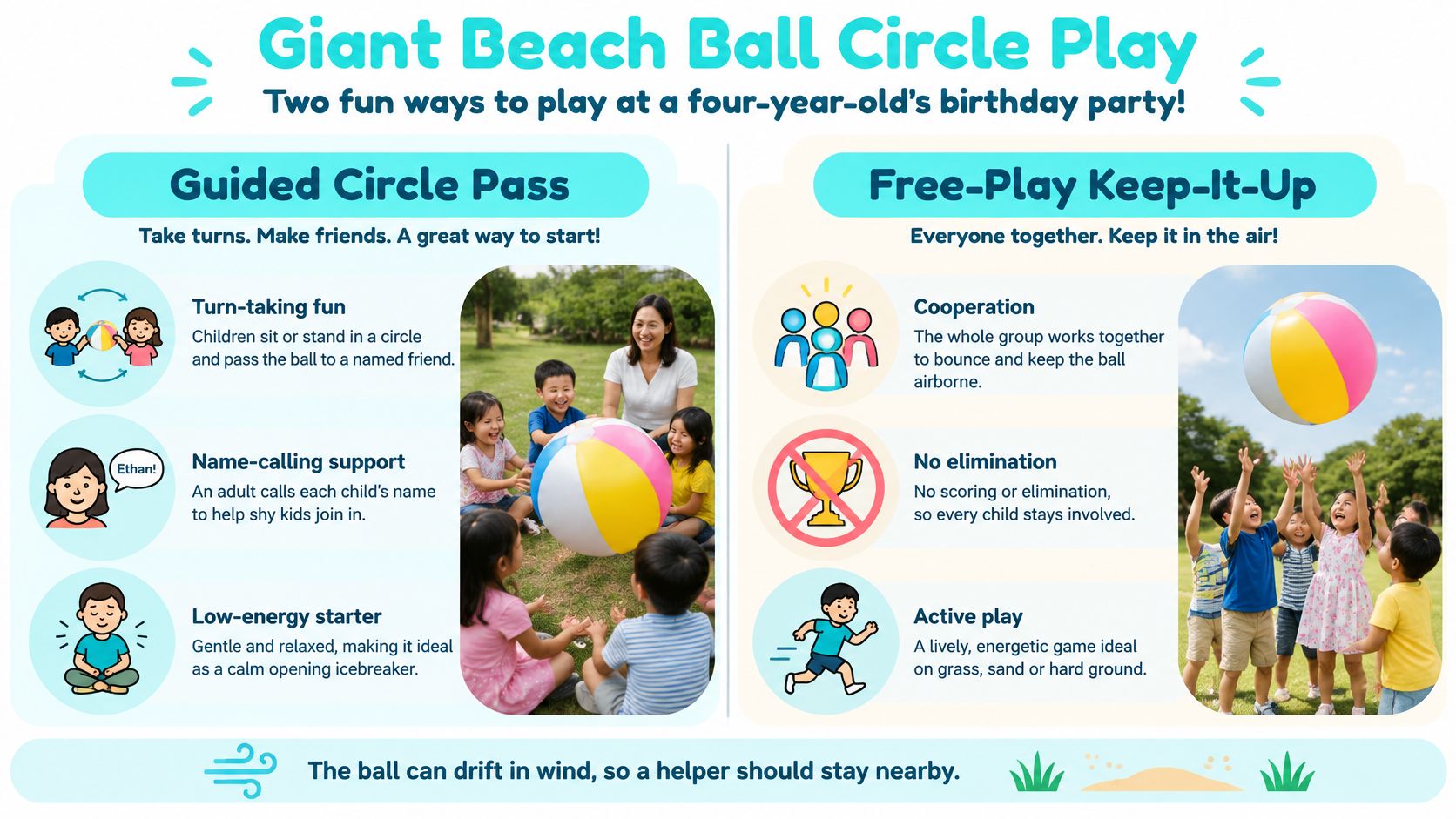
A giant beach ball is the safest first game for a small or medium crowd that is still warming up. Six to about twenty children can pass, roll, bounce, and keep it off the ground. Energy stays low to moderate. Nobody keeps score, so mixed-age siblings and shy guests can join without a loser.
Preschool and kindergarten sports days in Singapore often open with this circle. Family day carnivals use it the same way when toddlers and parents share one ball. Outdoors is worth the trouble. A wrist-accelerometer study of 78 Singapore preschoolers found a median of about 0.5 hours a day in moderate-to-vigorous activity, and observational work found that 34.0% of children engaged in MVPA during outdoor preschool observations, compared with 7.7% indoors, in the Singapore integrated activity guidance circulated to GPs. A soft ball on a wide park or beach gives you that outdoor movement without a race.
How a small circle actually runs
Say you have six children under a void deck. One rule is enough: pass to the child whose name you call. Call a shy child early, before the group speeds up. For a park party near twenty, split into two circles so nobody stands and waits. Watch the road edge. A light ball travels farther than you think.
- Call the name before every pass: The ball is clearly theirs, so shy children step in.
- Keep a spare pump and a helper: A soft ball or a runaway ball stops play in seconds.
- Book early morning or late afternoon: Midday sun on an open field drains four-year-olds before cake.
Practical rule: If the ball leaves the shade, pause and reset the circle. Don't chase it into a carpark.
2. Bloop Bubble Soccer (Junior Session)
A bubble suit turns a light bump into a laugh. Choose it for around ten active children who want noisy, physical play; larger groups need rotation. Energy is high. Use a park or large field, not a tight void deck. Watch suit heat and children who need to watch before joining.
Children wear inflatable Bloop suits and play gentle soccer at walking pace. The bubble takes the bump, but this age still needs firm limits: no wrestling, charging, or pinning another child against the ground. Keep the first round especially calm, then let the group add speed only when everyone stays upright.
The Bloop Bubble Suit Soccer party package costs $540 for a 1.5-hour session for 10 participants. Each additional participant costs $42. Every birthday package includes trainers and transport, so let the trainers control contact and substitutions. ZOVB's guide to how Bloop bubble games work in Singapore shows the format before you book.
Sport Singapore and the Health Promotion Board revised the Singapore Physical Activity Guidelines on 12 June 2022. For your party, keep movement short and varied, and avoid long waits. Split guests into small teams and rotate them frequently.
Keep the round shorter than their excitement
- Cap each round at 3 to 5 minutes: Then stop for water and swap players.
- Let nervous children watch first: A side view often gets them in by round two.
- Assign one adult to watch faces, not the ball: Red cheeks and slow movement mean it is time for a break.
For a corporate family day, run a gentle children's round first and let adults take a slower one later. At a four-year-old birthday, finish while they still want more.
3. Land ZOVB Bowling with Oversized Pins
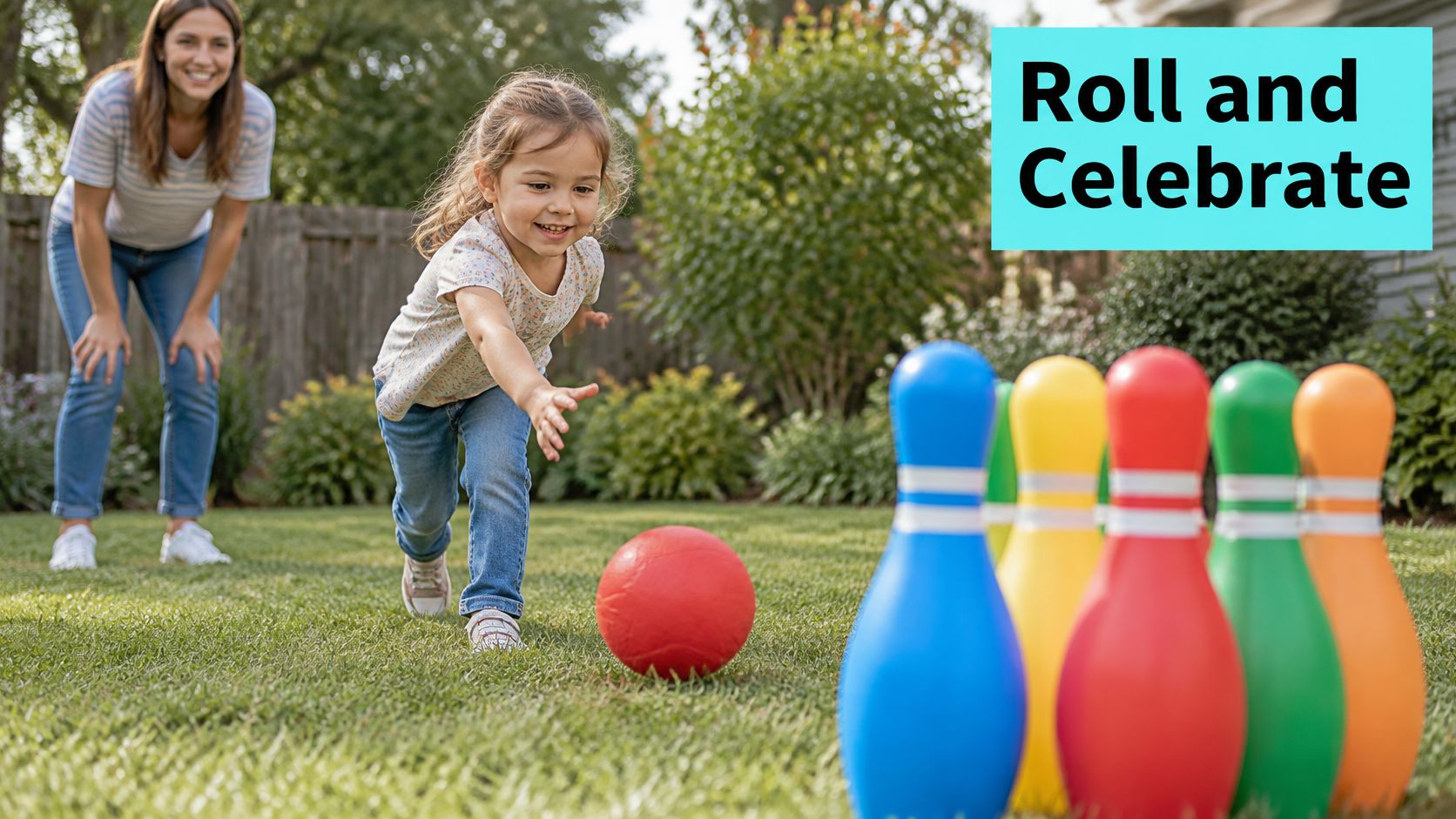
Four to twelve children, low energy, and a flat patch of ground. That is the whole brief for oversized pins and a soft ball. Roll, crash, cheer. The target is big enough to see, which matters when the instruction has to stay at one step. Backyard parties, playdates, and school stations all work. The thing to watch is a child stepping over the line, or a queue that becomes the game.
The Singapore Physical Activity Guidelines name throwing, running, jumping, and social play as suitable movement for preschoolers. Two rolls are throwing practice without a race. At a family day, this station sits beside other low-impact games so children who hate chasing still stay in the programme.
Set the lane before the first roll
Mark the bowling line with a rope or cones, and keep throwers behind it. Give each child two or three rolls. Celebrate every pin, not only a strike. Above eight children, open a second lane and keep the waiting spot short and shaded.
Say a condo function room holds ten children. Two lanes, one helper on each, and a three-roll limit means the line keeps moving. Count a good game by who had a turn, not by who cleared the pins fastest. Parents can play the same lane after the children, which helps at a mixed family carnival.
4. Cornhole Toss for Preschoolers
This is the quiet station. Two to ten children, very low energy, almost no running. Bean bags go through a hole in a raised board. It suits shy guests and children who would rather stand with a parent than sprint. Family days in Singapore often run it with toddlers and adults side by side. Community carnivals use it as the calm corner for mixed ages.
Put the board close enough that a four-year-old can land a bag in the first two throws. A target that feels impossible ends the game.
The Early Childhood Development Centres Code of Practice says outdoor activity directly under the sun should be minimised from 11am to 4pm, with a shaded water-and-rest break every 15 minutes. Cornhole can live under a void deck or a tent while a louder game waits for late afternoon. A game can be right for the age and still be wrong if children queue in full sun.
Make the toss easy to see
- Stake or weight the board: Small feet bump a light board off flat ground.
- Drop the throwing line: Comfort beats a regulation distance.
- Use bright bean bags: Children find them on grass and on tiles.
- Pair each child with a buddy: A parent or older sibling keeps turns fair without a whistle.
A playdate of four can share one board for about ten minutes, then swap to a ball game. At a carnival, two boards stop the line from becoming the activity. Watch for boards that tip toward little toes.
5. Kin Ball Team Circle
Twelve to sixteen children, with adults inside the circle, is the sweet spot. Energy sits in the middle. A large bright ball stays in the air, and players can be asked to push it or carry it. For four-year-olds, cut that back to three words: lift, pass, hold. Watch the drop. A big ball landing on a smaller child is the main risk, along with rules that get too wordy.
Schools and companies in Singapore already use the full game when the point is group participation, not a winner. Parents and children can share one circle at a family day carnival. If older siblings are in the same gathering, our notes on team building games for 10 to 12 year olds show how you stretch the day upward without dropping the preschoolers out of their own round.
Full-day preschools are expected to provide one hour of gross-motor activity daily, including at least 30 minutes outdoors, as set out in ECDA's reply on preschool activity time. One Kin Ball circle will not cover that hour. It can be a cooperative block inside a longer sports day or camp.
First round stays tiny
Put one adult with each small group. Keep the first round to a few minutes, then add players. Tell us the youngest age when you book so we set a preschool session, not a full competitive match. Say a class of fourteen joins parents for a family carnival station. Adults hold the circle, children call "pass", and you stop while they are still keen.
6. Water Tag Summer Splash Game
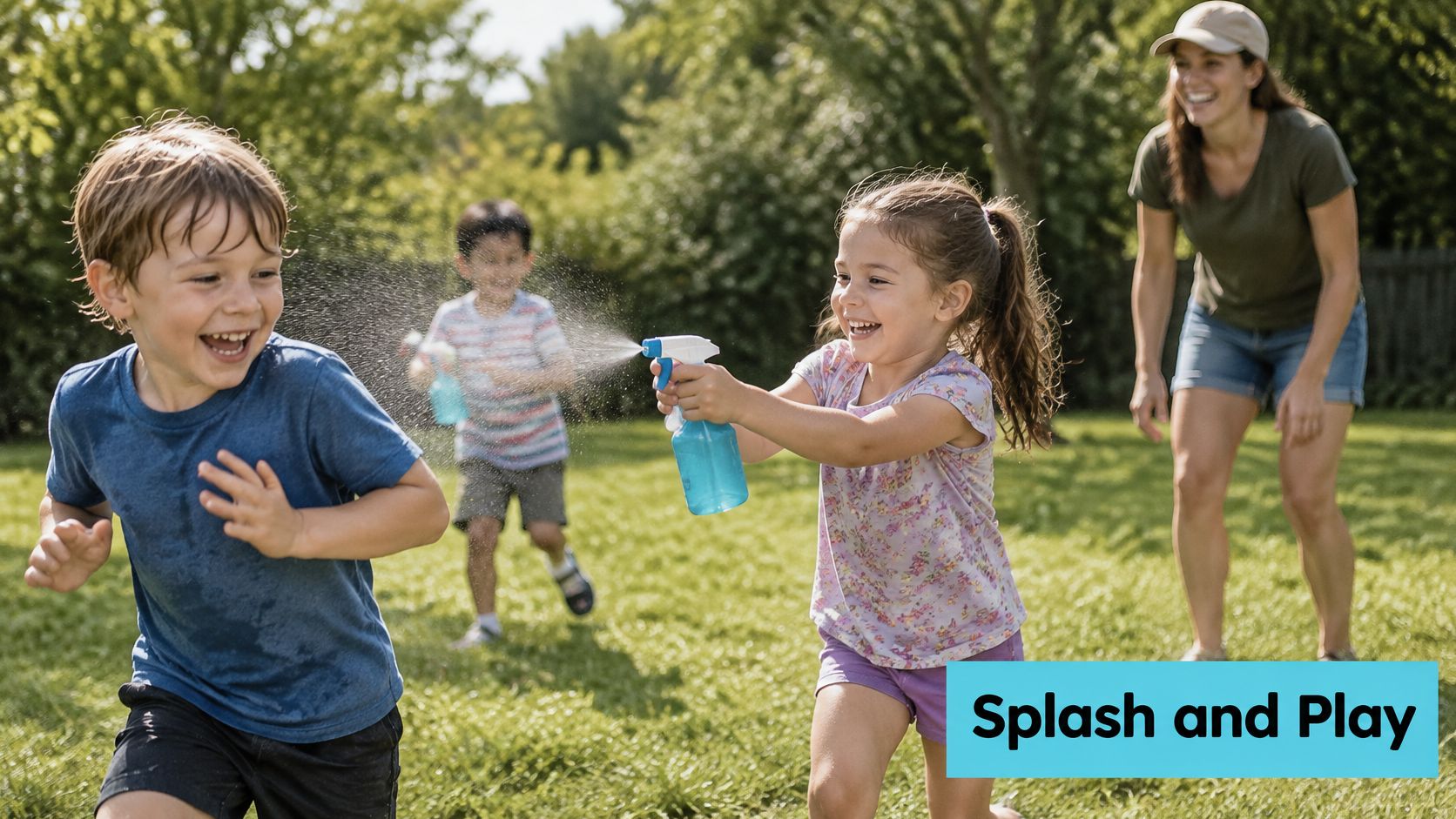
Pick this as the finale for roughly ten children who can run, stop and swap turns. Energy is high. It suits a home backyard, a nearby park or another chosen venue with cones for edges and shade close by. A four-year-old version needs one rule only: stay inside the cones, spray gently, then pass the cannon to the next child. Watch three things: lightning risk, wet tiles near the edge, and pressure strong enough to sting a small face.
Water Tag runs on cannons, vests, buckets and water bombs in a marked zone, and gentle spray is the right setting for preschoolers. If you would rather put children inside a ball on water, read our Water ZOVB pool party activity guide before choosing. A Water Tag session can be booked for 10 participants for one hour at $300, with 10 cannons and vests plus 4 buckets holding 30 water bombs. Use it as the active outdoor finish, with shade and drinking-water breaks still built in.
Before anyone gets wet
- Mark the zone: Cones or a rope, and children stay inside it.
- Stage towels and spare clothes: A child who can't get dry won't enjoy cake.
- Read the afternoon forecast: Don't book into a thunderstorm window.
- Still break for drinking water: Spray is not a drink.
If the only waiting spot is in direct sun, move the game or cut it short.
7. Mini Floorball Stick and Ball Game
Eight to twelve children who can hold a light stick. Energy runs moderate to high. The watch-outs are a stick that swings up, and a goal so small that nobody scores.
Sticks stay low
Floorball is a lightweight stick and a plastic ball. A junior setup lets four-year-olds dribble, pass, and aim without years of practice. Schools already use it on sports days. Corporate family days can field mixed-age teams if parents take the slower lane. Teach one safety rule and stop play if it breaks: sticks stay below the knee and never swing near a friend. Use large soft balls first, mark small goals, and keep matches short.
The HealthHub early childhood activity guidance calls for at least 60 minutes of moderate-to-vigorous activity in a safe environment, and it limits recreational screen time to under one hour. A stick-and-ball station is movement. It is not a screen break between games.
If the group is already hot, a sunny-park splash is the cooler cousin, and you should switch to water rather than push another stick drill.
Say a buddy sports afternoon mixes four-year-olds with older siblings. Give the younger group the soft ball and a walking-only first minute. Allow a jog only after sticks stay low. We rent the floorball equipment. You still want an adult by each goal. Check junior stick length and soft edges before the first pass, and don't run this one in a crowded void deck.
8. Junior Tchoukball Catch and Rebound
Picture a family carnival court, not a league match. Teams of two to four children a side, moderate energy, no contact. Players pass a ball and aim it at a rebound frame. The junior version is catch, throw, and rebound. It suits school sports days, family carnivals, and birthdays where parents share the activity. Watch crowding at the frame, and throws that get too hard.
Children below age 15 were 13.8% of Singapore's population in 2024, down from 14.0% in 2023, and there were 33,703 live births in 2024, compared with 33,541 in 2023, in the SingStat population report. Those births aren't a count of four-year-olds. They do remind carnival planners to expect siblings and parents on the same court. Small sides handle that mix better than one giant game.
Drills first, frame second
Start with throw-and-catch. Add the rebound frame only after most children can hold a soft, large ball. Keep teams at two to four. We set a Tchoukball party session from the ages, headcount, and venue you send, with a junior-friendly run of the game rather than a full adult match. Alternate turns so adults don't take every rebound.
A class sports day can run three short rounds, then rotate the class to a calmer station. Success is a caught pass and a ball that hits the frame, not a scoreboard. If a child would rather feed balls than throw, that role still counts as playing.
How the eight four-year-old party games compare by group size, energy and setting
| Game | Best Group Size | Energy Level | Best Setting |
|---|---|---|---|
| Giant Beach Ball Circle Play | Whole group | Low to moderate | Open grass, sand or hard ground |
| Bloop Bubble Soccer (Junior Session) | Small supervised teams | High | Clear outdoor area |
| Land ZOVB Bowling with Oversized Pins | Individuals or small teams | Low | Flat lawn or hard court |
| Cornhole Toss for Preschoolers | One-on-one or small teams | Low | Small outdoor or covered area |
| Kin Ball Team Circle | Several players in a group | Moderate | Open space for a guided circle |
| Water Tag Summer Splash Game | Adaptable to different group sizes | High | Open outdoor space in warm weather |
| Mini Floorball Stick and Ball Game | Small teams | Moderate to high | Flat indoor or outdoor area |
| Junior Tchoukball Catch and Rebound | Small teams of 2–4 children per side | Moderate | Flat, clear indoor or outdoor space |
Matching the Right Game to Your Crowd and Energy
Start with headcount and space. Then choose the energy.
Six children under a void deck point you to Cornhole Toss or oversized bowling. Both are calm, shaded, and easy to pause. A park party of thirty needs stations, not one long game. Put a beach ball or a Kin Ball circle on the grass, bowling or cornhole under a tent, and save Water Tag or a junior Bloop round for open ground with trainers watching.
Mix one calm station with one active game. Four-year-olds fade if every round is a chase, and they fidget if every round is a queue. Two or three short blocks, water, then cake, beats a single hour-long match. The same split works when the guest list isn't all four. Older siblings take the faster lane. Younger ones stay on the big, slow target.
Companies and schools can scale that idea.
- Family day carnival: Run parallel stations so mixed ages stay busy at once.
- Corporate team hour: Use cooperative circles and non-contact rebounds so colleagues aren't asked to be athletes.
- Student sports day: Rotate classes through stick games, target games, and a splash finale.
You can hold the party at home, in a backyard, at a nearby park, or at another venue you choose. Additional venue or facility charges may apply, depending on the activity and location. If you'd rather not plan every rotation, we offer birthday party packages in Singapore. You send the theme. We handle the cake, the activities, and the programme flow. Trainers and transport are included, and you can combine activities in one party by sending the mix.
Selected packages show the scale. A Bloop bubble suit soccer party is $540 for a 1.5 hour session for 10 participants, and each extra participant is $42. A Water Tag party is $300 for a 1 hour session for 10 participants, with 10 cannons and vests and 4 buckets holding 30 water bombs. A Kin-Ball party is $600 for 1.5 hours, suitable for 12 to 16 participants. Send the date, the venue, and the headcount, and the quotation follows those requirements.
ZOVB SG rents these games for birthday parties, school sports days, corporate family days, and community carnivals across Singapore, from Bloop Bubble Soccer and Kin Ball to Tchoukball, floorball, cornhole, and Water Tag. Match a void deck playdate or a park party by sending your date, venue, and how many four-year-olds you're hosting. Visit ZOVB SG to browse the activities and start a booking.