Thirty-two pupils, four relay teams, one strip of field in the late morning sun. Half the children are queuing, two have drifted towards the water cooler, and the same four fast runners have taken every leg. That's the moment most teachers and parents realise the games they picked weren't built for a whole group of 10 to 12 year olds. They were built to produce a winner.
Children at this age are old enough to follow rules, hold a position and keep score. They're not old enough to shrug off twenty minutes of standing around. The formats that hold up are the ones where every child touches the ball, makes a decision or carries a job, and where a round ends before attention does. The thinking behind team cohesion drills for young players applies whether the group is a school class, a birthday party or a mixed-age family day.
Singapore adds its own constraints. Heat turns a 10am field into a hazard, school halls get booked out months ahead, and guest lists routinely mix a seven year old cousin with a twelve year old team captain. Each game below is assessed against those conditions: where it fits, how many children it handles, what space it needs and what to check before you commit a booking.
Table of Contents
- 1. Bubble Soccer for Team Building (Bloop Bubble Soccer Style)
- 2. Kin-Ball Team Ball Game
- 3. Spikeball Team Net Game
- 4. Tchoukball Team Passing Game
- 5. Cornhole Toss Team Game
- 6. Floorball Team Sport
- 7. Combat Skirmish Laser Tag Team Game
- 8. Water Tag Summer Team Game
- 9. Giant Beach Ball Team Challenge
- 10. Human Bowling Team Challenge (Land ZOVB Bowling Style)
- How the 10 team games compare for 10 to 12 year olds
- Choosing the Right Game for Your Next Gathering
1. Bubble Soccer for Team Building (Bloop Bubble Soccer Style)
Strap a twelve year old inside a clear inflatable shell and the first thing they do is laugh, then try to run, then bounce off a teammate. Bloop bubble soccer puts every player in that shell and plays a short football match, so the collisions that would end a normal game become the running joke.
The teamwork is a side effect of the clumsiness. A child in a bubble can't pivot quickly or see their own feet, so the only way a team moves the ball upfield is by calling positions out loud. Quiet players end up talking because there's no other option.
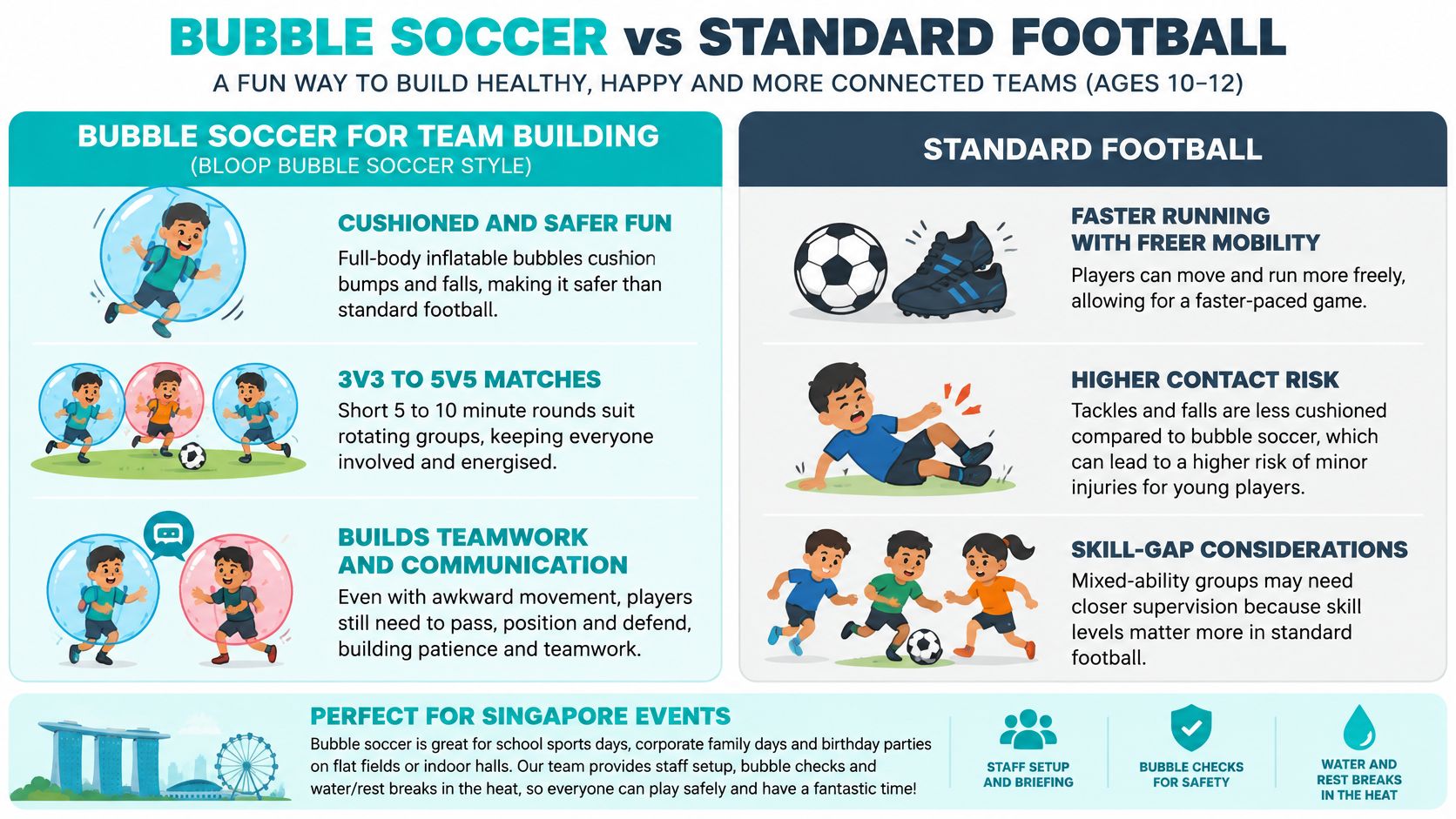
Heat decides the schedule more than anything else. Sport Singapore's heat stress management summary classifies a WBGT of 31 to 33°C as moderate heat stress, with reduced outdoor activity and regular shaded breaks advised, and at 33°C and above it asks organisers to minimise outdoor activity, increase breaks and fluids, and cool participants actively. Children are named as more vulnerable to heat stress, and a sealed bubble traps body heat fast.
It's a fixture at school sports days and inter-class cups, a favourite at corporate family days where parents and children land in the same team, and a reliable finale at birthday parties once the warm-up games are done.
Check these before you confirm
- Pitch and surface. Confirm dimensions with the venue before you count bubbles, because bubble count is set by clear floor area, not by guest numbers.
- Timing. Early morning or after 4pm, with rounds of four to five minutes and water between each one.
- Contact rules. State them out loud, pair adults with children where it's a family day, and pull any child who looks flushed rather than waiting for them to say so.
- What the format involves. Read up on what bubble soccer involves and how Bloop bubble games run in Singapore before you promise children a full match.
2. Kin-Ball Team Ball Game
Kin-Ball uses a ball close to two metres across, and three teams share the court at once. One team serves the giant ball into the air while calling another team's colour, and the named team has to keep it off the floor. Because the ball is huge and slow, no single child can dominate it. Three players have to get underneath it together or it drops.
Children in Primary 3 to 6 already spend 2.5 hours a week in PE, according to a Ministry of Education parliamentary reply, so the appeal of Kin-Ball isn't extra fitness. It's a different use of that hour, one where the group result is visible to everyone at the same time.
Running it without chaos
- Demonstrate the serve first. Children copy a demonstration far faster than they absorb a spoken rule about not letting the ball touch the floor.
- Rotate captains every round. Every team should have a child who has called a colour at least once.
- Keep rounds to six or seven minutes. The ball is heavy to hold overhead, and tired arms make the game collapse into wrestling.
- Book shade or a hall. A ball that size catches wind, and a gusty open field turns every serve into a chase.
It slots neatly into a wider programme of sports bonding activities for school groups where several games share one venue and one run sheet.
Our Kin-Ball package runs 1.5 hours for 12 to 16 participants at $600, which suits a single class or a birthday group that wants one game done properly rather than six done badly.
3. Spikeball Team Net Game
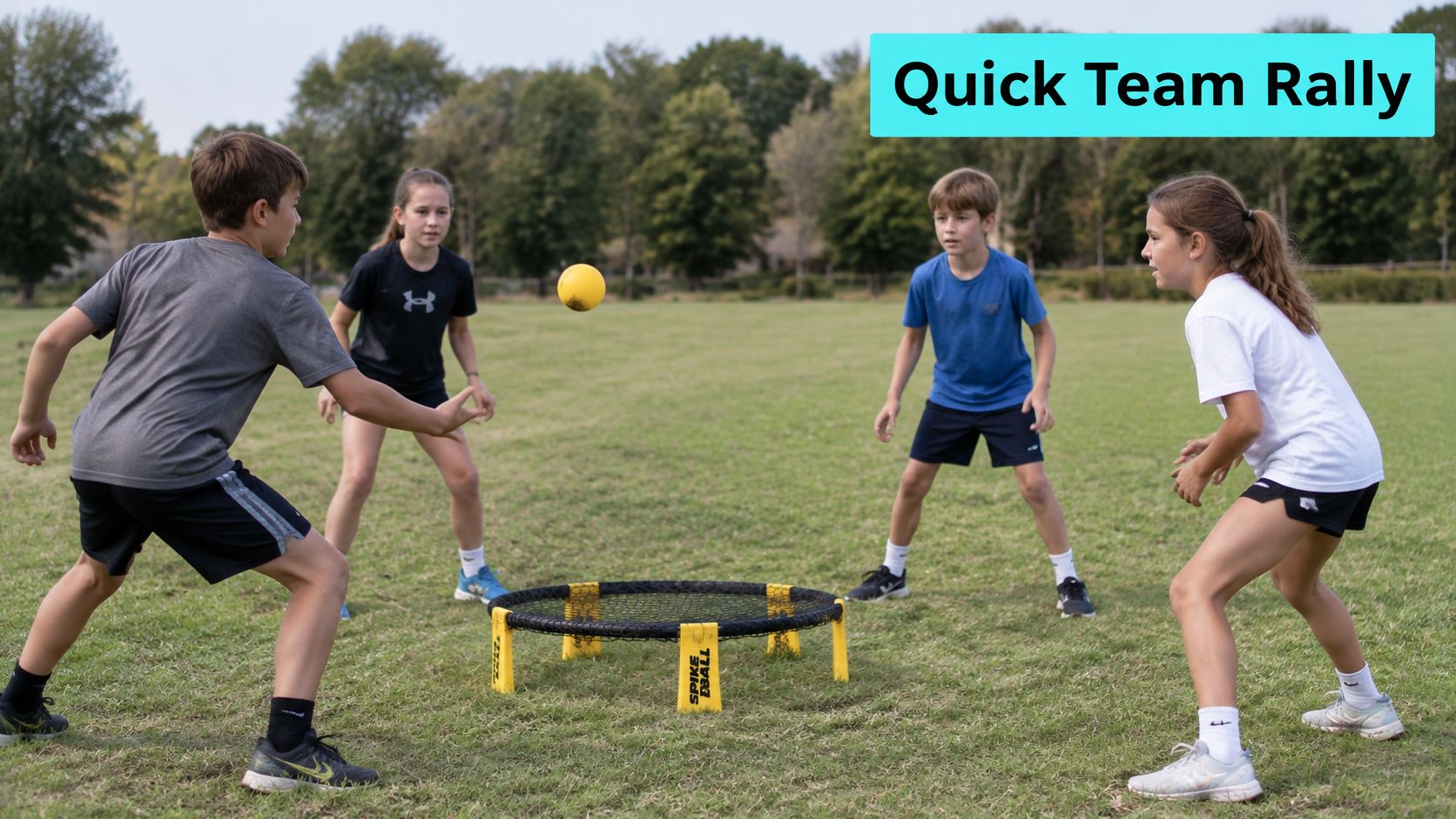
Spikeball takes the smallest footprint on this list and fills a gap in a programme fastest. Two-player teams bounce a small ball off a circular net, and rallies restart within seconds, so there's no long setup between points and no long walk to fetch a ball.
The format answers a problem most event plans ignore: dead time. The Health Promotion Board's guidance on physical activity variation pushes organisers towards varied, activity-based games rather than one long match, and parallel nets are how you get there. Every additional net running at the same time means fewer children waiting and more children playing.
Setting up a rotation that actually rotates
- Bring enough nets for the group. Each net in play seats a full match, and children between rounds can run short scoring challenges on the spare nets instead of standing in a queue.
- Pair by confidence, not by friendship. A nervous child beside a calm one rallies longer than a nervous child beside the class champion.
- Shade the net area. A small net in full sun becomes a punishment by 11am.
- Run a bracket with a plate final. A knockout where half the teams are eliminated in the first ten minutes empties the field.
Spikeball works as a station at family days, a between-games filler at birthday parties, and a lunch-break option for corporate groups in a park.
4. Tchoukball Team Passing Game
If your group includes children who flinch at contact, Tchoukball removes the problem instead of managing it. Players pass a ball and score by hitting a rebound net so the ball bounces back and lands outside the forbidden zone. No tackling, no marking, no collisions, but plenty of sprinting and quick decisions.
Organised school sport here is not a niche. The National School Games began in 1959 with seven primary-level sports and by 2025 had grown to 29 sports with more than 66,000 student-athletes competing, about 1,000 more than in 2024, as The Straits Times reported. Children arrive at your event already used to rules, rotations and scoring, which is why a sport with a slightly odd rulebook isn't the barrier adults assume it is.
A game that needs referees isn't a problem to solve. It's a chance to hand three children a role with real authority for the whole session.
The ten-minute briefing that saves the match
- Walk through one scoring sequence. One demonstration of a legal shot explains more than five minutes of rule reading.
- Use half-court rules for mixed groups. Smaller zones and a slower ball keep younger or less confident players in the rally.
- Book the hall early. Indoor courts disappear during school term, and Tchoukball without a proper rebound net isn't Tchoukball.
- Train two child referees per court. They keep scoring honest and give children who don't want to compete a genuine job.
5. Cornhole Toss Team Game
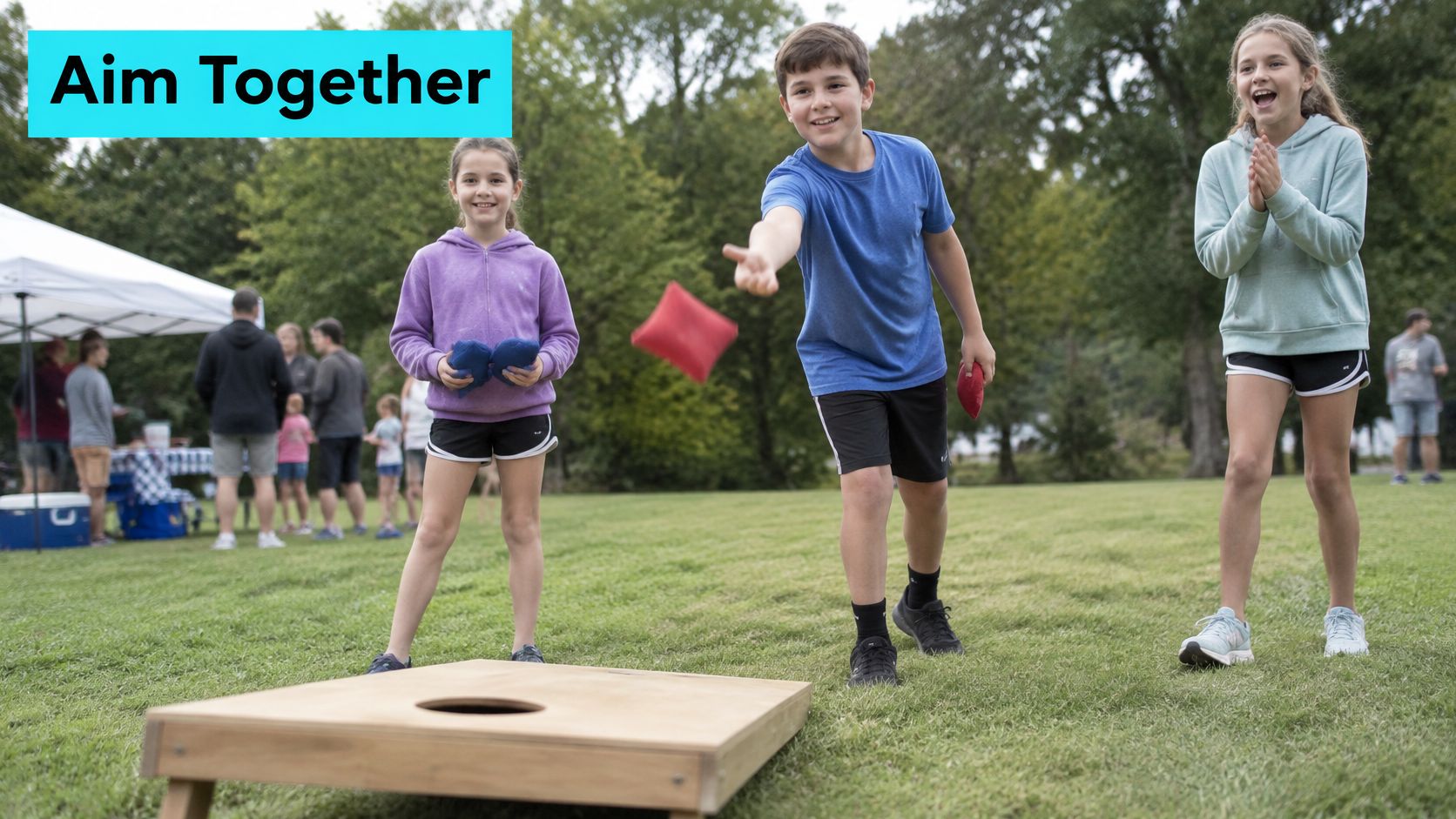
Not every station needs to raise a heart rate. Cornhole is the one adults drift towards between louder rounds, and the one where a child who hates being watched can take a short throw with three people nearby instead of thirty.
Singapore's national children's sport research programme examines participation patterns, motivations and barriers for children aged 3 to 12, per Sport Singapore. At an event, the barriers matter more than the game list. A child who has never thrown a bean bag in front of classmates doesn't need a harder game. They need a lane where the throw is short, the crowd is small and a teammate is talking them through it.
Turning it into a station, not a sideshow
- Name the teams on a bracket board. A visible ladder with team names gives a low-exertion game the same weight as the loud ones.
- Run four to six lanes. Cornhole collapses into a queue the moment there are fewer boards than pairs.
- Keep bags dry and boards shaded. Damp bags fly badly and hot boards warp.
- Place it beside a high-energy game. Cornhole is the rest station that lets a child who's overheated stay involved without sitting out.
Birthday parties use it as the quiet game between active rounds, corporate family days use it as a mixed-generation challenge, and carnivals use it as a stall that never has a long line.
6. Floorball Team Sport
Floorball is the closest game here to real exercise. Lightweight plastic sticks, a perforated ball and rules that ban body contact give children the speed of hockey without the collisions that worry parents. It suits the ones who want to be out of breath.
That intensity is what justifies its slot. The Health Promotion Board recommends vigorous activity at least three times a week for children aged 7 to 18, sedentary screen time under two hours a day, and a five to 10 minute movement break whenever sitting runs past 90 minutes. One floorball block inside a sports day or school camp covers a large share of that.
Venue is a major trade-off. Floorball needs a hard, dry floor, so it belongs in school halls, covered courts and indoor function rooms rather than open carnival fields. The same booking doubles as a wet-weather and heat plan, which is why it fits inter-house competitions, school camps and corporate family days held indoors.
Equipment and format notes
- Offer three stick lengths. A stick at hip height gives control; a stick at chest height gives frustration.
- Run passing and dribbling drills first. Twenty minutes of drills makes the match that follows watchable.
- Keep teams small. Four or five a side with rolling substitutions keeps everyone moving in a hall.
- Watch stick height. A raised stick is the one real injury risk, so whoever referees should call high sticks early and often.
Equipment can be rented for a self-run game, and a hosted party package costs $550 for a 1.5 hour session for 10 participants, with each additional player at $40. For a birthday party of 12, the per-head pricing stays predictable.
7. Combat Skirmish Laser Tag Team Game
Laser tag sells itself to a ten year old and worries the adult paying for it. Both reactions are reasonable. Infrared taggers, a briefing, and a set of team objectives turn a shooting game into a planning exercise, provided the missions are built around objectives rather than plain elimination.
The format rewards the children who think before they move. A team that splits into scouts, defenders and a runner will beat a team of faster children who all charge the same corner, and that lesson lands harder than any talk about communication.
Supervision note: Confirm the operator's minimum age and equipment fit before booking, insist on a safety briefing with clear rules on physical contact and out-of-bounds zones, and walk the site yourself. Laser tag fails when the arena is confusing, not when the equipment is old.
Making the missions do the work
- Give each team a job list. Scouts, defenders, a base guard and a runner. Rotate at half time so nobody is stuck in the same role.
- Score objectives, not tags. Capturing a flag or holding a point for 60 seconds produces more talking than a body count.
- Balance teams by temperament. Pair the loudest organiser with the quietest strategist, then split the two fastest children across different sides.
- Plan an indoor venue for haze or storms. If you're weighing wet-weather options, this list of indoor activities in Singapore covers formats that survive a downpour.
It suits older children in this age band, corporate team-building with cross-department teams, and birthday parties where the group wants a competitive highlight rather than a bouncy castle.
8. Water Tag Summer Team Game
Water Tag is the answer to a very Singaporean problem: a party booked for 3pm in a month when the field is radiating heat. Players carry water-squirting toys, complete missions across marked zones, and cool down while they run. It's the one game on this list that children ask to play again immediately.
It also does real work against the national benchmark. The Singapore Physical Activity Guidelines guidebook sets an average of 60 minutes of moderate- to vigorous-intensity aerobic activity a day across the week for ages 7 to 17, and reports that only 30% of boys were classified as active in the cited national activity profile. A cooling game that keeps children sprinting in short bursts does more for that target than a queue-based activity that only looks busy.
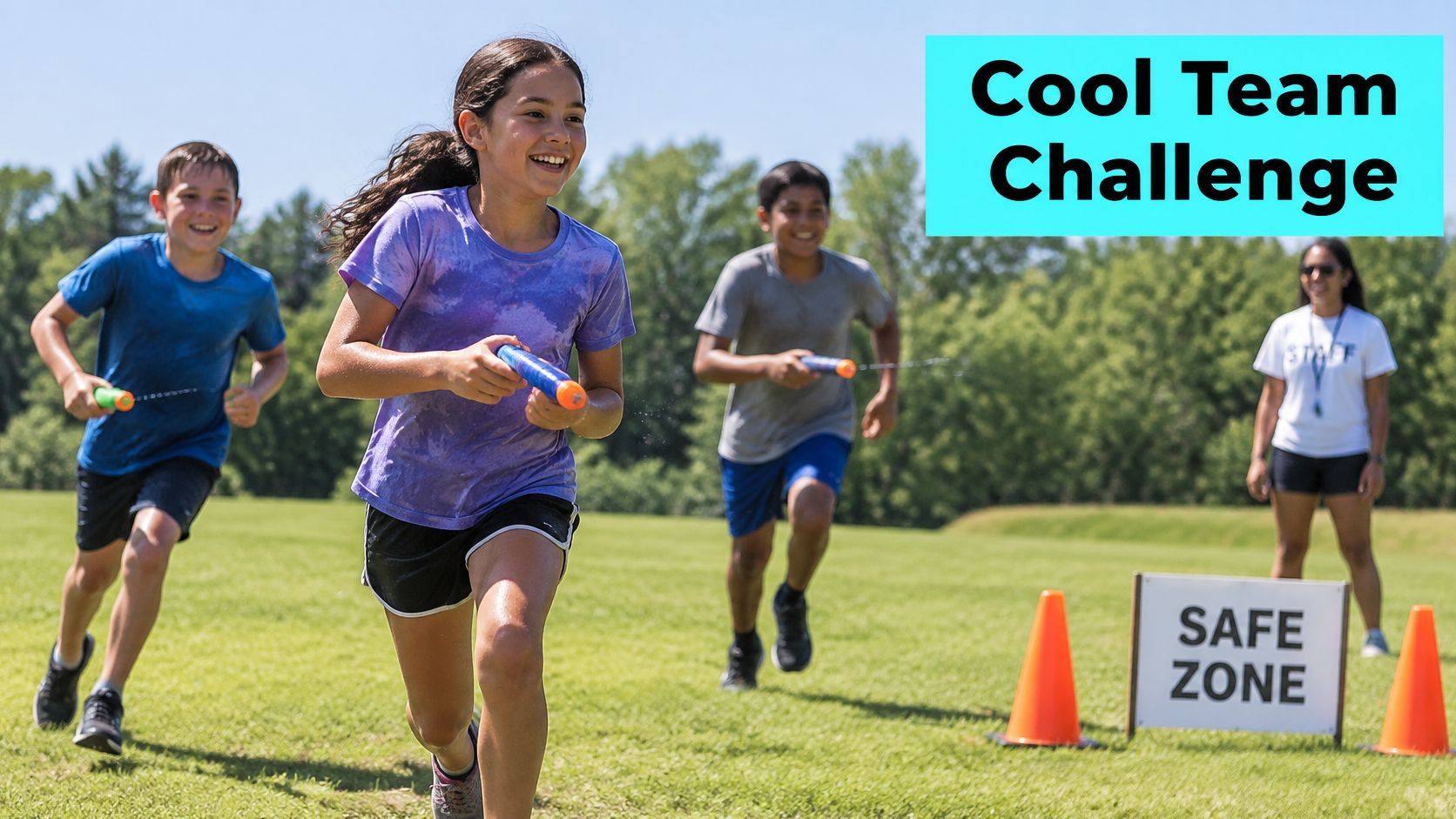
The safety setup that makes it work
- Cone the boundaries and mark refill points. Children run further when they know where the edge is.
- Ask for grip footwear. Wet grass plus rubber slippers is the number one cause of a ruined party.
- Bring towels, spare clothes and a shaded rest zone. Half the group will be soaked within ten minutes.
- Schedule it for the afternoon with a storm check. Peak midday heat is the wrong slot, and Singapore thunderstorms arrive fast.
School sports days use it as a cooling finale, family day carnivals treat it as a dedicated wet zone, and birthday parties book it for gardens and open fields with access to a tap.
9. Giant Beach Ball Team Challenge
A ball that weighs almost nothing changes who can play. The giant beach ball scales from a simple relay to a cooperative keep-it-up challenge, and none of the formats ask for height, sprint speed or a strong throw.
That matters with a mixed class. In a parliamentary reply on childhood obesity data, the Ministry of Health stated that 13% of children across primary, secondary and pre-university levels were overweight or severely overweight by BMI-for-age classification in 2024. Games scored on speed push a share of every group to the edge. A giant ball rewards timing, calling and patience, which spreads the work across the whole team.
Three formats that work with a mixed group
- Keep-it-up countdown. Teams keep the ball off the ground for a set number of touches, counting out loud together.
- Over-under relay. Pass overhead, then between the legs, down the line. Simple, loud and needs no skill.
- Cooperative carry. Teams move the ball across a marked line without hands above shoulder height, which forces negotiation.
Design rule: If the task can succeed while one child stands still, it isn't a team challenge. Rewrite it until the group fails without that child.
The same principle runs through classic outdoor challenges that boost collaboration: the obstacle is the conversation the task forces.
Because it asks little of the body, the beach ball tolerates slots other games can't. Run it indoors in a school hall or function room when afternoon storms close the field, use it as a low-heat station between active rounds at a family day carnival, or give it a shaded corner at a birthday party where one adult can watch the whole game. Outdoors, check the wind first and move inside when the ball starts acting like a sail.
10. Human Bowling Team Challenge (Land ZOVB Bowling Style)
Bowling has a structural problem at children's events. One child rolls, nine watch. Land ZOVB Bowling turns that into a team activity with large balls and inflatable pins, and the fix isn't the equipment. It's the roles.
Give each team a thrower, a caller who reads the remaining pins, a pin-setter, and a scorer, then rotate every frame. The child who can't throw straight becomes the one who notices that the left side is wide open. That reframing is worth more than any consolation prize, and it's the difference between a game that includes a reluctant ten year old and one that excludes them.
Booking note: Build in enough lanes that a team never waits through more than one frame. Waiting is what breaks a game, not the scoring.
Keeping the queue moving
- Set up three or four lanes. Rotate teams between lanes so no group owns the "good" one.
- Put the scoreboard where everyone can see it. Visible scores keep children interested in other teams' turns.
- Pair younger children with an adult. Shared throws keep a small child in the game without a handicap.
- Combine it with a high-energy game. Bowling first, bubble soccer after, gives you a calm opening and a loud finish.
It's a station at family days where age groups rotate, a relaxed game between active rounds at birthday parties, and a corporate activity that gets people cheering for colleagues they barely know.
How the 10 team games compare for 10 to 12 year olds
| Item | Best For | Typical Format | Space Needed | Indoor or Outdoor |
|---|---|---|---|---|
| Bubble Soccer for Team Building (Bloop Bubble Soccer Style) | Lively, laughter-filled team play | 3v3 to 5v5; short rounds | Large, flat pitch or clear hall | Indoor or outdoor |
| Kin-Ball Team Ball Game | Cooperation and shared decision-making | Three players per team; keep the ball off the floor | Large open area | Indoor or outdoor |
| Spikeball Team Net Game | Quick partner rallies in small groups | 2v2 around a portable net | Small clear area | Indoor or outdoor |
| Tchoukball Team Passing Game | Non-contact play and fair competition | Seven players per team; score off rebound frames | Marked court with rebound frames | Mainly indoor |
| Cornhole Toss Team Game | Relaxed, mixed-age group activities | Pairs take turns tossing bags at a board | Compact area for boards and throwing lanes | Indoor or outdoor |
| Floorball Team Sport | Fast-paced, non-contact team matches | Five outfield players and a goalkeeper per team | Sports hall or covered court | Indoor or covered |
| Combat Skirmish Laser Tag Team Game | Strategy-focused missions | Teams use tag equipment in objective-based games | Arena with obstacles and cover | Indoor or outdoor |
| Water Tag Summer Team Game | Cooling, energetic activities | Teams use water toys for tag or missions | Designated water-safe play area | Outdoor |
| Giant Beach Ball Team Challenge | Mixed-age cooperation and icebreakers | Team relays, passing or keep-up challenges | Open grass or large hall | Indoor or outdoor |
| Human Bowling Team Challenge (Land ZOVB Bowling Style) | Easy-to-learn, turn-based group play | Teams of two to five take turns knocking down targets | Clear lane or play area | Indoor or outdoor |
Choosing the Right Game for Your Next Gathering
Three questions settle most of this. How many children are playing, how much clear space do you control, and will the session sit in sun or shade? Answer those before you commit to a format, because a game that needs a long stretch of grass and full shade will fail in a school hall, and a format built for eight children will collapse with 40.
Then build a run sheet rather than a list. One high-energy anchor (bubble soccer, floorball, water tag) plus one calmer station (cornhole, human bowling) keeps the group moving without a single long queue. Rotate teams through both every 20 to 25 minutes, and write the water break into the sheet as a scheduled activity. If the WBGT climbs into the moderate band, shorten rounds and shift games into shade rather than cancelling, and keep an indoor backup for the afternoon storm window.
Shade is a booking constraint, not a comfort detail.
Staffing is the constraint nobody budgets for. A facilitator per station, plus one floating adult watching for overheating and one handling first aid and water, is the minimum that lets several games run at once. Booked through ZOVB SG, facilitators explain the games, run the activities and keep participants engaged, which frees your adults for water duty, shade checks and supervision at the edges.
Group sizes are shifting too. Family gatherings in Singapore now include more small playdates and mixed-generation parties alongside the big school events, so games that scale from six children to sixty earn their place on a rental list far better than formats built for one exact headcount. Floorball and water tag absorb a crowd; Spikeball and cornhole still work when only a handful of cousins turn up.
When you're ready to book, share your chosen activities, event date, venue and estimated headcount with ZOVB SG for a quotation. Programmes are customised to a group's age and physical capability, so a class of 10 year olds and a corporate family day get different itineraries drawn from the same game list.
ZOVB SG supplies the games in this list as rentals and facilitated sessions across Singapore, including Bloop Bubble Soccer, Land ZOVB Bowling, Kin-Ball, Tchoukball, floorball, Spikeball, cornhole, laser tag, water tag and the giant beach ball, with packages shaped around your participant count and event duration. Tell us whether you're planning a school sports day, a corporate family day, a carnival or a birthday party, and we'll put together a run sheet that keeps every child in the game rather than in a queue. Visit ZOVB SG to browse the games and send over your event details.