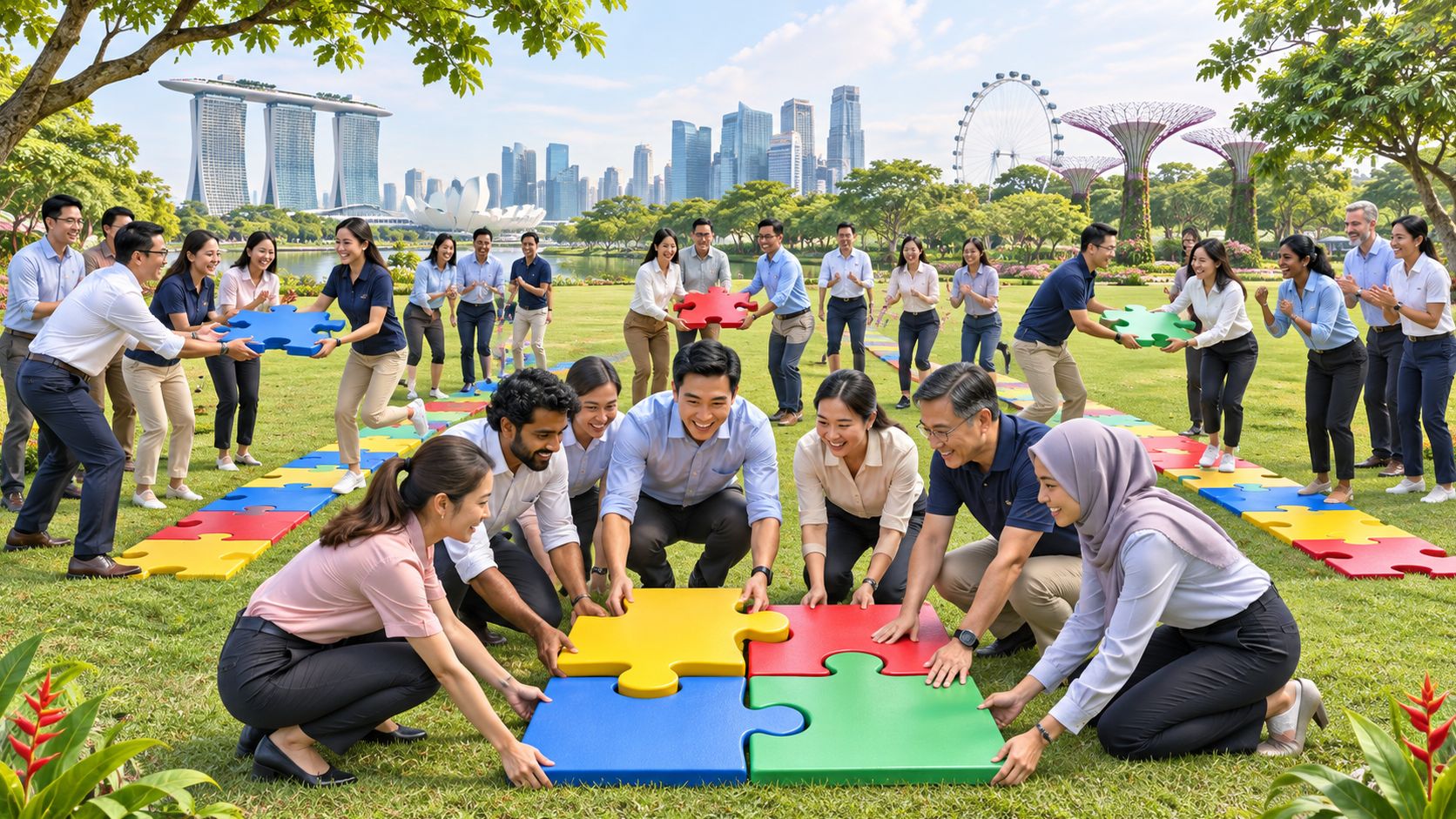
A hundred and twenty people are booked for a family day, the inflatables are up, and by mid-morning half the crowd is standing in the shade checking their phones because only 22 of them can play at once.
That's not a game problem. It's a format problem. Large-group events in Singapore fail for three predictable reasons: too few parallel stations, too much standing in the sun, and rules that don't carry to the back of the queue. Fix the format and the same crowd stays involved for three hours.
Every game in this guide to team building games for large groups is judged on the three decisions that settle a Singapore event: how many people can take part at once, how much space it needs, and whether it survives a wet-season afternoon or a hot open lawn. Capacity decides your queue length. Space decides your venue bill. Weather decides whether your contingency plan is a canopy or an indoor hall, and in Singapore you will need one or the other most months of the year.
The list is grouped by event fit rather than alphabet or novelty, so you can shortlist against the event you're running: corporate team building, a school sports day, a family carnival or a community event. Some games scale by adding stations, others by rotating short rounds, and a few only work below a certain headcount. Each entry states which case it falls into.
If you're building a wider programme around an off-site, browse retreat activities by group size before you lock the schedule. Choose your anchor game first, then fill the gaps with activities that handle the overflow crowd, because a strong main activity cannot rescue an event where half the guests are spectators with nothing to do.
Table of Contents
- 1. Bloop Bubble Soccer (ZOVB SG)
- 2. Giant Beach Ball Games
- 3. Kin-Ball
- 4. Spikeball
- 5. Tchoukball
- 6. Floorball
- 7. Cornhole Toss
- 8. Combat Skirmish Laser Tag
- 9. Water Tag
- 10. Land ZOVB Bowling
- How the 10 large-group games compare on space, weather and age fit
- Choosing the Right Game for Your Next Large Event
1. Bloop Bubble Soccer (ZOVB SG)
Bubble soccer is the format that closes the fitness gap in a mixed corporate crowd. Each player wears an inflatable body-sized bubble, so collisions are padded and the advantage usually held by the fittest person in the room disappears.
Run it as a round-robin. Four teams of five, six-minute matches, two pitches side by side, and a scoreboard that updates after every round. That structure keeps 40 people playing and 80 watching with something to shout about, rather than one long match with a queue behind it.
Sport Singapore recorded more than 12,000 sign-ups across its National Youth, Corporate and Masters Games in 2017, spanning 20 sports and 10 para-sports, and linked the corporate competitions with camaraderie, staff bonding, leadership and teamwork (Sport Singapore). The lesson is structural: multiple sports, multiple categories, short formats.
What Works and What Doesn't
- Works: mixed departments, a referee on every pitch, 90-second changeovers between matches.
- Doesn't: 20-minute matches in direct sun, one pitch for 60 people, no whistle discipline.
Practical rule: Book shade for the changeover zone, not the pitch. Players overheat while waiting their turn, not while playing.
Send your venue size and headcount when you request a quotation, so the pitch layout and rotation plan can be sized before the day.
2. Giant Beach Ball Games
Say you're running a carnival for 200 people and a third of them are under eight. Oversized inflatable balls handle that crowd in a way a football never will: the ball is big and slow, so a five-year-old and a grandparent can both get a touch in the same rally.
Keep-up rounds work best as an opener. Count consecutive touches per team, reset on a drop, and run six balls across the field at once. Nobody queues, nobody gets eliminated, and the noise level rises within two minutes.
Singapore's participation base supports that approach. Sport Singapore's national data puts regular participation at 76% in 2025, up from 66% in 2019, with only 12% of residents classified as non-participants (Sport Singapore). That's a crowd with mixed fitness, which is exactly why a low-skill, high-access format beats a technical one.

Setup notes that matter
- Ball size: match it to the age mix. Chest-height balls for under-10s, larger for teens and adults.
- Wind: giant balls catch it. On an open field, play across the wind, not into it.
- Backup: confirm an indoor area when booking. A passing storm ends this game in 30 seconds.
Use it as the icebreaker, then move the crowd to something structured.
3. Kin-Ball
Three teams share one court in Kin-Ball. One team serves the giant ball into the air while calling another team's colour, and that team has to keep it off the floor. Because players work together to keep the giant kinball in play, everyone on the court is involved in every serve. That makes it the strongest format here for a company that wants conversation, not just running.
That structure matters when the room isn't naturally chatty. Gallup's country-level data reports that 14% of Singapore employees were engaged in 2025, while 71% were not engaged and 15% were actively disengaged (Gallup). A game that forces three people to coordinate under one ball does more for a quiet team than a speech about values.
On the three decisions that shape a large-group event, Kin-Ball scores well. Headcount scales with courts rather than queuing. Space demand is one hall or a flat outdoor patch per court. Weather is a solved problem, because the game runs indoors as easily as out, which is rare for something this size.
Running It for a Big Group
Rotate in waves. With 60 people, run five courts of three teams, eight-minute rounds, then reshuffle so nobody plays with the same colleagues twice.
- Practice first: two minutes of serving practice before scoring starts.
- Score visibly: a flipchart or a screen, updated by a runner.
- Mix deliberately: split departments rather than letting cliques form teams.
ZOVB SG facilitators explain the games, manage activities and keep participants engaged, so the reshuffling happens on schedule without the organiser chasing stragglers. For groups that want the multi-sport version, combine Kin-Ball with Bloop Soccer, Tchoukball, Floorball and Spikeball in a single rotation.
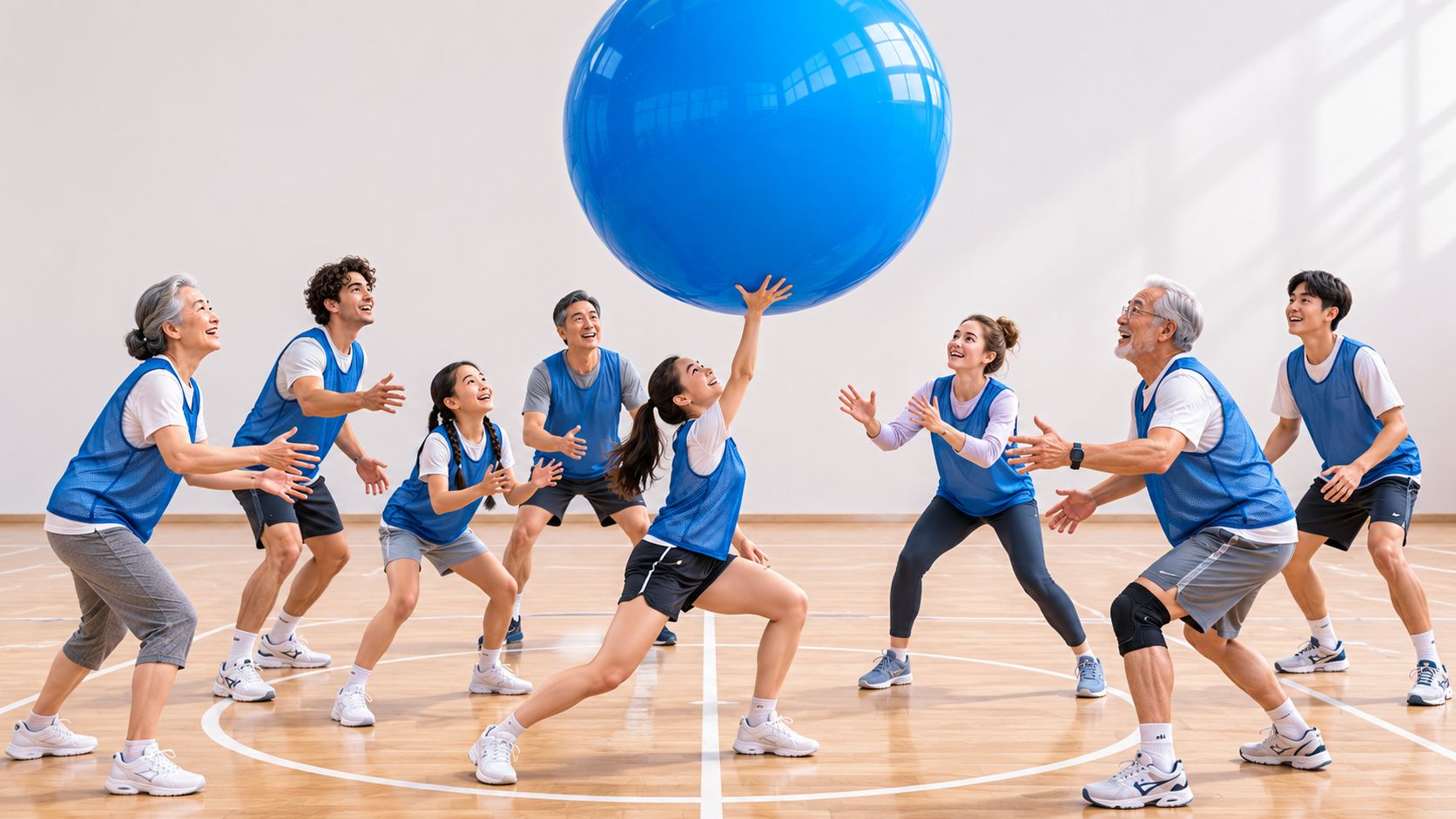
The ball is large enough to fill a person's view, so give each court a clear ceiling or play outdoors, or the serve finds the rafters.
4. Spikeball
Space, not headcount, is usually the constraint in Singapore. Spikeball handles that better than almost anything here: a net needs roughly three metres of floor, so eight nets fit into a school hall or a corner of a car park and 32 people play at once.
It's quick to learn, which makes it a natural lunchtime tournament. Teams of two, first to 11, rotate the losing pair off. Within 20 minutes a 40-person group has a rhythm and a leaderboard.
The case for pairing physical play with social mechanics is solid. AIA Singapore's 2025 Corporate Wellness Study found 89% of employees engaged with physical wellness initiatives and 83% with social ones, against 67% for mental wellness, and 79% of participants rated the physical activities effective (AIA Singapore). Formats that combine the two get the strongest uptake.
Carnival zone checklist
- Courts: one net per four players keeps queues under three minutes.
- Shade: nets sit low, so one gazebo covers two courts.
- Scoring: printed scorecards beat apps. Volunteers don't want to log into anything.
Plan for a hard, flat surface. Grass kills the bounce and the rally with it.
5. Tchoukball
Tchoukball is the answer when you need a competitive sport that won't put anyone in hospital. Players throw at a rebound frame and the ball must land outside a no-go zone, and defenders can't intercept. No contact, no blocking, so a mixed-gender, mixed-age group can play a real match.
Two frames fit on a single badminton court, which makes it one of the most space-efficient games here. It runs indoors happily, so rain is no threat, and a court of seven-a-side means 14 players active per frame pair with the rest rotating in.
Schools use it well because the rules force passing and positioning over strength. Set up two frames, mark the forbidden zone in tape, and brief the no-blocking rule twice. Enforcement matters. Most knocks in this game come from players crowding the frame or skipping the warm-up, not from the format itself, so keep referees strict on spacing from the first whistle.
Know Your Group Before You Set the Format
Participation data from Sport Singapore's National Sport & Exercise Participation Survey is a useful reminder for organisers: any large group spans a wide range of fitness levels and ages, and your format has to absorb that spread.
For a 120-person sports day, that means two Tchoukball frames for the competitive stream, plus a lower-intensity station running in parallel for anyone who wants to opt out without sitting alone. Rotate squads every eight minutes so nobody guards the frame for a full hour.
Non-contact doesn't mean no risk. Warm up shoulders and ankles for five minutes before the first match.
6. Floorball
Floorball is the wet-season insurance policy. Plastic sticks, a perforated ball, a covered hall, and the event runs whatever the radar says. That reliability is why it dominates school and corporate leagues here.
For large groups, run short matches in a league format. Four-a-side, 10-minute games, rolling substitutions every two minutes. A hall with two courts cycles 80 players through a 90-minute block.
Schools already plan this way. The Ministry of Education requires every student to be offered at least five different physical activities across at least two game categories, with a minimum of 16 curriculum hours per activity (MOE syllabus). A sports day built around rotating stations, rather than one sport for the whole cohort, matches that logic.
Hall checks before you book
- Floor: timber or sealed concrete. Rough outdoor courts shred sticks.
- Boards: hire rink boards so balls don't spend the afternoon in the next court.
- Sticks: order left and right-handed. A left-hander holding a right-handed stick is a spectator.
MOE also notes that schools make sports facilities and equipment available for unstructured play during recess and after school, which is the same principle behind a free-play zone at a carnival (MOE).
7. Cornhole Toss
Not every station should raise the heart rate. Cornhole keeps grandparents, pregnant staff and the colleague with a bad knee in the game, and it does it without anyone feeling singled out.
Walking is one of the most common activities among residents here: Sport Singapore's published data shows 46% of residents named walking or outdoor walking as a top activity in the previous four weeks (data.gov.sg). A low-exertion target game fits that base far better than another running drill.
Space is the other reason it earns a slot. A lane needs only a short strip of flat ground, so boards fit along the edge of a field, a ballroom or a void deck without displacing the main activity. It runs indoors or out. The weather limit is rain, not heat, because players barely exert themselves and the boards suffer more than they do.
Lane Planning
Eight board sets in lanes of two, two players per board, gives 32 people playing and a queue that moves every four minutes.
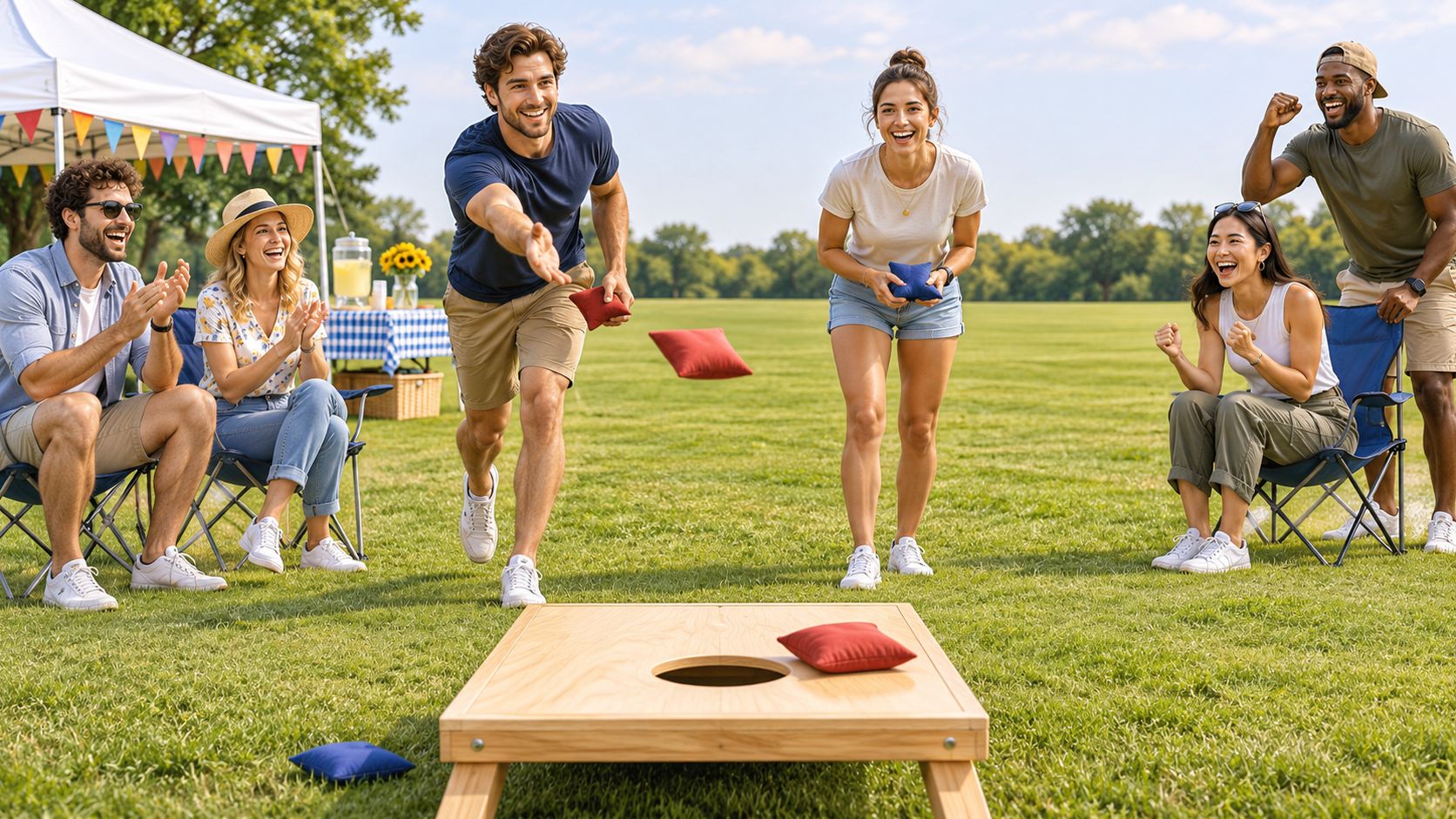
- Board count: one board set per 12 expected guests is a safe starting ratio.
- Bracket: a printed 16-team bracket turns a casual toss into an afternoon storyline.
- Storage: boards warp in the rain. Keep them under cover until play starts.
That throughput is why cornhole suits family days and carnivals better than corporate fitness formats. Grandparents and kids play the same game at the same pace, and nobody needs a briefing to start. Score it as a mini-tournament and it holds a crowd for hours. Leave it as free play and it still fills the gaps between bigger stations.
Put cornhole next to the food queue, not away from it. People play while they wait and the queue stops feeling long.
8. Combat Skirmish Laser Tag
Laser tag scales by geography rather than by equipment. A zone holds 40 players in a mission round, and a 200-person event runs as five waves with a briefing tent between them.
Give every player a defined role, scout, support or attacker, and the game becomes a communication exercise instead of a running race. Brief the safety rules before every round, not once at the start of the day. People forget.
Mass events here already work at this scale. Sport Singapore reported that the 2017 GetActive! Singapore finale drew more than 680,000 people, with 13,000 sports-competition sign-ups including about 4,000 Corporate Games registrants (Sport Singapore). Parallel stations and timed waves are how those numbers get through a single day.
Wave Management
- Briefing tent: one marshal per 20 players, with a scripted two-minute briefing.
- Vests: colour-code by team and check batteries at the start of each wave.
- Water: a refill point at the exit of the zone, not at the far end of the field.
If your group skews teenage or youth, this pairs well with the formats in team building games for teens.
9. Water Tag
Water tag is the only game on this list that gets better as the temperature climbs. Blasters, buckets and a marked zone, and a crowd that's been wilting since lunch suddenly wants to run.
Heat management decides whether it's fun or a first-aid incident. Sport Singapore's heat guidance tells organisers to avoid the hottest period of the day, schedule activities during cooler hours, cut duration or intensity, and provide more frequent breaks (Sport Singapore). Water play doesn't exempt you from that.
Setup That Works
- Timing: run it in the late afternoon or early morning, outside the hottest stretch of the day.
- Boundaries: tape the zone and put a marshal on each side.
- Facilities: confirm drainage, changing areas and towels before you promise water play.
Non-negotiable: water games and phone cameras don't mix. Announce a dry zone for bags and devices, and keep a marshal on it.
For a pool-based version with the same energy, Water ZOVB suits kids of all ages and works well alongside a water tag zone.
10. Land ZOVB Bowling
Bowling is the safest crowd-pleaser here. Oversized equipment, clear scoring, no fitness requirement, and a queue you can see from across the field. Set six lanes and 60 people cycle through in 40 minutes.
The design question is inclusion, and it's the one most event briefs skip. Inclusive Design Week 2025, run with SG Enable and disability-sector representatives, put practical accessibility tools and case studies in front of organisers (GovTech). The takeaway for a carnival is unglamorous: offer parallel ways to contribute instead of forcing everyone into the same action.
Making It Inclusive
- Lanes: one lane per 10 guests, minimum.
- Scoring: team totals, not individual, so nobody's score sits on display.
- Roles: rotate a scorer and a ball-returner role for people who'd rather not throw.
Bowling needs flat ground. A slope turns a straight roll into a donation to the next lane.
How the 10 large-group games compare on space, weather and age fit
Read this table as a shortlisting tool, not a spec sheet. Start from the row that matches your event type, then check the two columns that kill most large-group plans in Singapore: how much ground the game needs and what happens when the afternoon storm arrives.
| Item | Best For | Space Needed | Weather Fit | Age Range |
|---|---|---|---|---|
| Bloop Bubble Soccer (ZOVB SG) | High-energy team bonding | Flat, open pitch with safe run-off | Heat can be tiring; plan breaks and hydration | Older children and adults; not suited to very young children |
| Giant Beach Ball Games | Inclusive family activities and icebreakers | Open lawn, covered court, or indoor hall | Wind and rain can affect outdoor play | Children, adults, and seniors |
| Kin-Ball | Teamwork and communication activities | Marked court or open field | Suitable for indoor or outdoor play with enough space | Mixed ages and abilities |
| Spikeball | Fast-paced games in a compact area | Small, level playing area; multiple courts can fit | Provide shade or cover for daytime play | Young adults and older children; less suited to very young children |
| Tchoukball | Non-contact team play and tactical skills | Court space with rebound nets and markings | Best on a covered court or a dry hard surface; wet ground makes rebounds unreliable | Mixed-age and mixed-gender groups |
| Floorball | Indoor school or corporate sports | Hard court or covered hall | Well suited to indoor or covered venues | School groups and adults |
| Cornhole Toss | Relaxed, accessible group activities | Little space; lanes can accommodate multiple games | Outdoor boards need protection from humidity | Young children, adults, and seniors |
| Combat Skirmish Laser Tag | Strategy-focused team missions | Arena or outdoor zone with a safe area | Runs indoors or outdoors; outdoor zones need a dry-weather backup plan | Older children, teens, and adults |
| Water Tag | Active outdoor play in hot weather | Defined outdoor play zone with water access | Best for hot weather; not suitable indoors | Children, families, and adults |
| Land ZOVB Bowling | Family activities and carnival circuits | Flat, open ground with space for lanes | Designed for outdoor play on dry, flat ground; keep a covered alternative ready for rain | Mixed ages and fitness levels |
A few pairings save real planning time. If your venue is a covered hall, floorball, Kin-Ball and Tchoukball stack well because they share the same hard-surface requirement, so one venue booking covers three stations. If you are on open lawn, bubble soccer, giant beach ball games and land bowling share the flat-ground requirement, and you can run them in parallel zones without moving equipment between rounds.
The weather column deserves more weight than the others. A game that fits your space and ages perfectly still fails if it has no wet-weather answer. For outdoor-first games like water tag and land bowling, decide the rain plan before event day rather than during it.
Age fit is the column organisers most often overestimate. Mixed ages and abilities covers Kin-Ball and cornhole. It does not cover bubble soccer or laser tag for the youngest guests, so family events need at least one row from the inclusive end of the table alongside the high-energy picks.
Choosing the Right Game for Your Next Large Event
Three questions settle most of the shortlist before you call a single vendor.
How many people play at once? Count simultaneous players, not headcount. Eight cornhole boards keep 32 people active. One bubble soccer pitch keeps 10. If your event runs to a few hundred guests across three hours, you need enough parallel capacity that each guest gets at least two turns at something.
What does the space allow? Open lawn suits bubble soccer, giant beach balls and land bowling. Covered halls suit floorball and Kin-Ball. Spikeball needs a hard, flat surface of about three metres per net. Water games need drainage, a changing area and a venue that has agreed to them in writing.
What does the weather do at 2pm? In Singapore, that question breaks more events than budget does. Build the run sheet so the highest-exertion activity sits in the cooler morning hours or late afternoon, and keep one covered-hall activity in reserve as the swap. Communicate a programme change as a schedule adjustment rather than a cancellation, and people stay for the rest of the day.
Then layer the audience. Corporate groups need roles and short debriefs so the interaction is visible to the people paying for it. Schools need rotations across more than one game category, matching the breadth students already get in PE. Families and carnivals need stations that don't require a queue, plus at least one low-exertion option that keeps older relatives playing rather than watching.
Where a Rental Provider Fits
Most organisers don't need more game ideas. They need someone to own the run sheet, the equipment, the facilitators and the rain plan. Share your focus, group size and event date with ZOVB SG, and the team will tailor a plan with facilitators who explain each game and keep participants engaged, with arrangements confirmed around the games you select. Programmes are customised to the group's age and physical capability, so the rotation is set before the day rather than improvised on the field.
If you're still weighing formats against a different kind of programme, team building at Chronos One Eltham shows how indoor formats compare.
Pick two headline games, three rotation stations and one wet-weather backup. That combination handles almost any large group in Singapore.
ZOVB SG rents and runs the games in this guide, from Bloop Bubble Soccer and Kin-Ball to cornhole, floorball and water tag, and builds the rotation around your headcount, venue and date. Tell us your event type, group size and preferred date, and we'll come back with a quotation and a run sheet that fits. Visit ZOVB SG to browse the full activity list and start your enquiry.
The article is already complete through the final conclusion (## Choosing the Right Game for Your Next Large Event) and the closing call-to-action after ---. Every section, image, required link, and the <!-- COMPARISON_TABLE --> marker from the outline is already included, so no further sections remain to be added.